

This post is for couples in a K-1 case (including K-2 children), a CR-1/IR-1, F2A or adjustment of status case asked "What will you do about health insurance?" By the end you will know how to get a Marketplace Eligibility Notice and a plan price quote on HealthCare.gov step by step, which papers to keep, and why I suggest a paid travel medical policy for the trip of a K-1 beneficiary and K-2 children. Everything below was checked on the official pages on October 25, 2026. The screenshots come from a real application made in November 2026, with names, numbers, ages and addresses hidden.
Before you start
To buy a Marketplace plan a person must live in the United States, be a U.S. citizen, national or lawfully present, and not be incarcerated. A K-1 entrant and K-2 children (nonimmigrant status) and a person with a pending I-485 are both on HealthCare.gov's list of eligible statuses. A beneficiary still abroad cannot be enrolled yet - for them you get a price quote (Step 1).
- Open Enrollment for 2027 starts November 1. Pick a plan by December 15 for coverage from January 1; Open Enrollment ends January 15.
- Outside Open Enrollment you need a Special Enrollment Period. Two fit our families: moving to the U.S. from a foreign country, and getting married, each within the past 60 days.
- From January 1, 2027 only Lawful Permanent Residents, Cuban or Haitian entrants and COFA migrants qualify for Marketplace savings. K-1 and K-2 entrants and pending I-485 applicants can still buy a plan, at full price.
If your state runs its own Marketplace - for example Covered California or NY State of Health - HealthCare.gov sends you there, and the screens have other names.
Step 1. Get a price quote before you apply
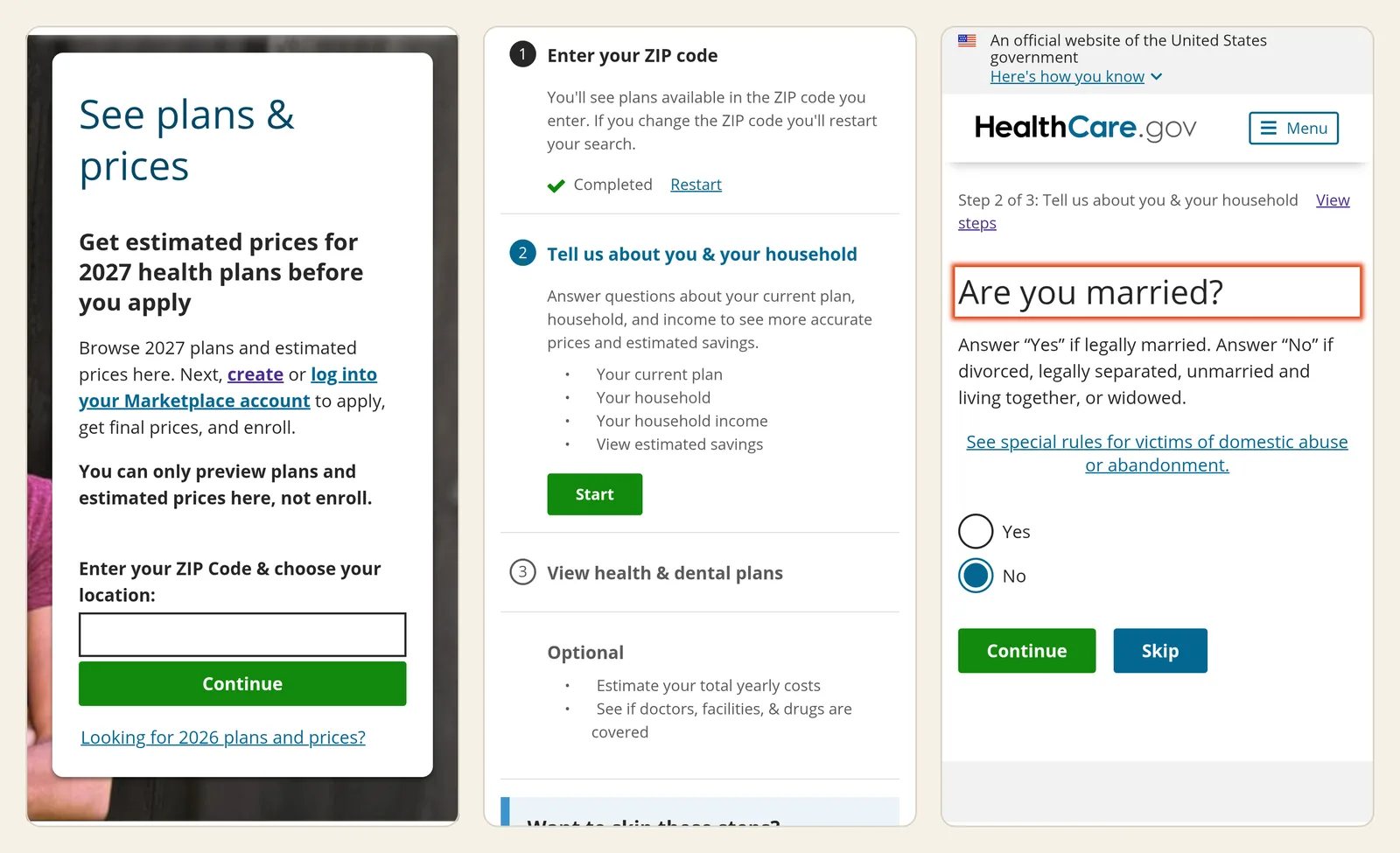
Go to healthcare.gov/see-plans. No account is needed: as the page says, "You can only preview plans and estimated prices here, not enroll." Here is what each screen asks and what to pick.
1. See plans & prices. Enter the ZIP code where you will live and press Continue. If the ZIP code covers more than one county, choose yours.
2. The three steps. Next to Tell us about you & your household press Start. You can also skip the questions and see full-priced plans, but then the prices are for a 35-year-old, not for your family.
3. Are you enrolled in a 2026 Marketplace health plan? If not, press Skip.
4. Are you married? Yes only if you are legally married. A K-1 couple before the wedding answers No.
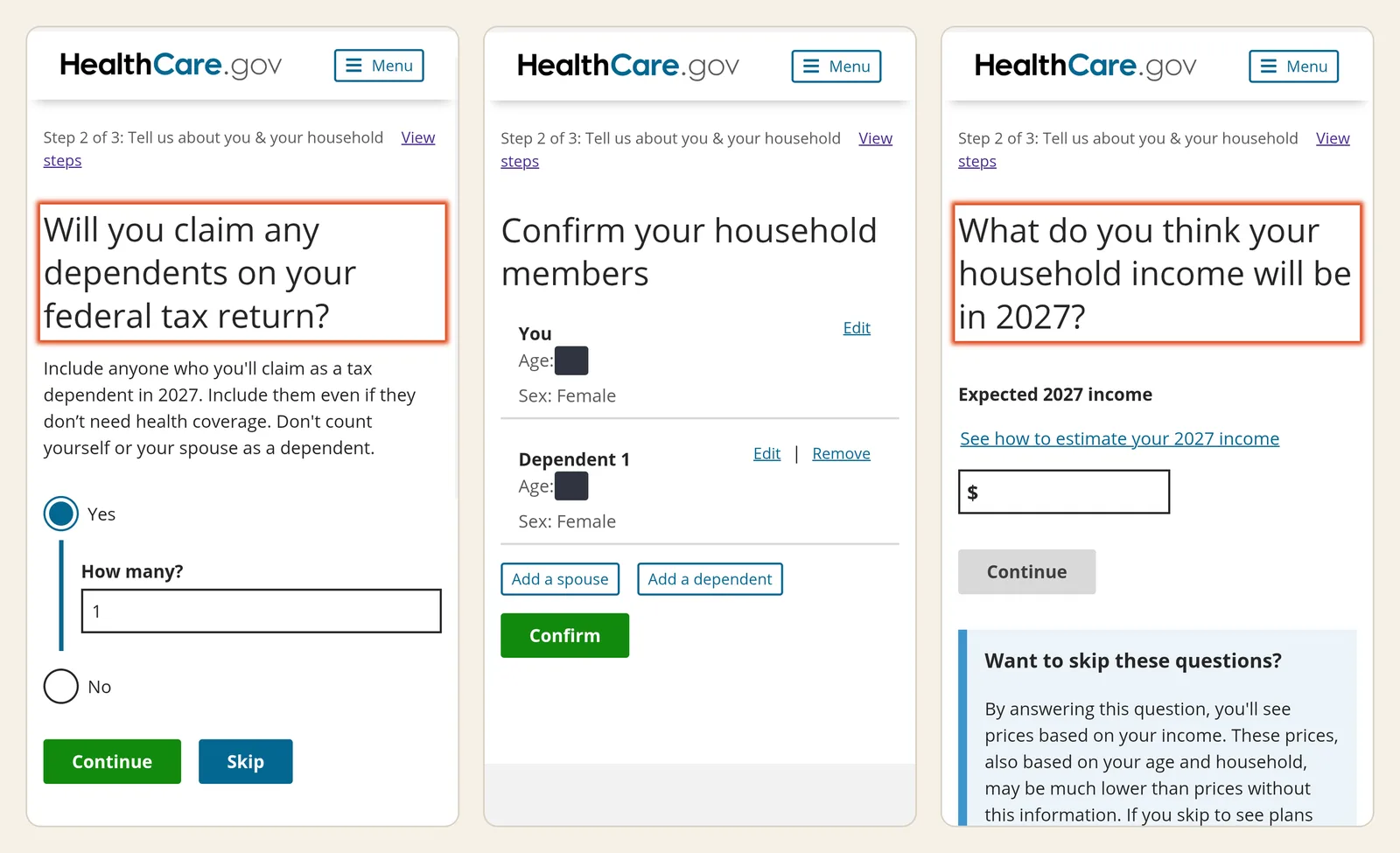
5. Will you claim any dependents on your federal tax return? Count the children you will claim as dependents in 2027, for example K-2 children. Don't count yourself or your spouse. Choose Yes, enter how many, and press Continue.
6. You, then each person. Enter the age and sex. Under Select any of these that apply tick what is true (pregnant, tobacco user and so on). If nothing applies, tick None of these.
7. Confirm your household members. Check the list. If someone is missing, use Add a spouse or Add a dependent, then press Confirm.
8. What do you think your household income will be in 2027? Enter your best estimate and press Continue.
9. Estimated savings overview, then the plans. Press View plans. The page may show a tax credit, but from January 1, 2027 a K-1 or K-2 entrant or a pending I-485 applicant cannot get it. So on each plan look at the full price: the figure after "was" in the line "Including a ... tax credit - was $...".
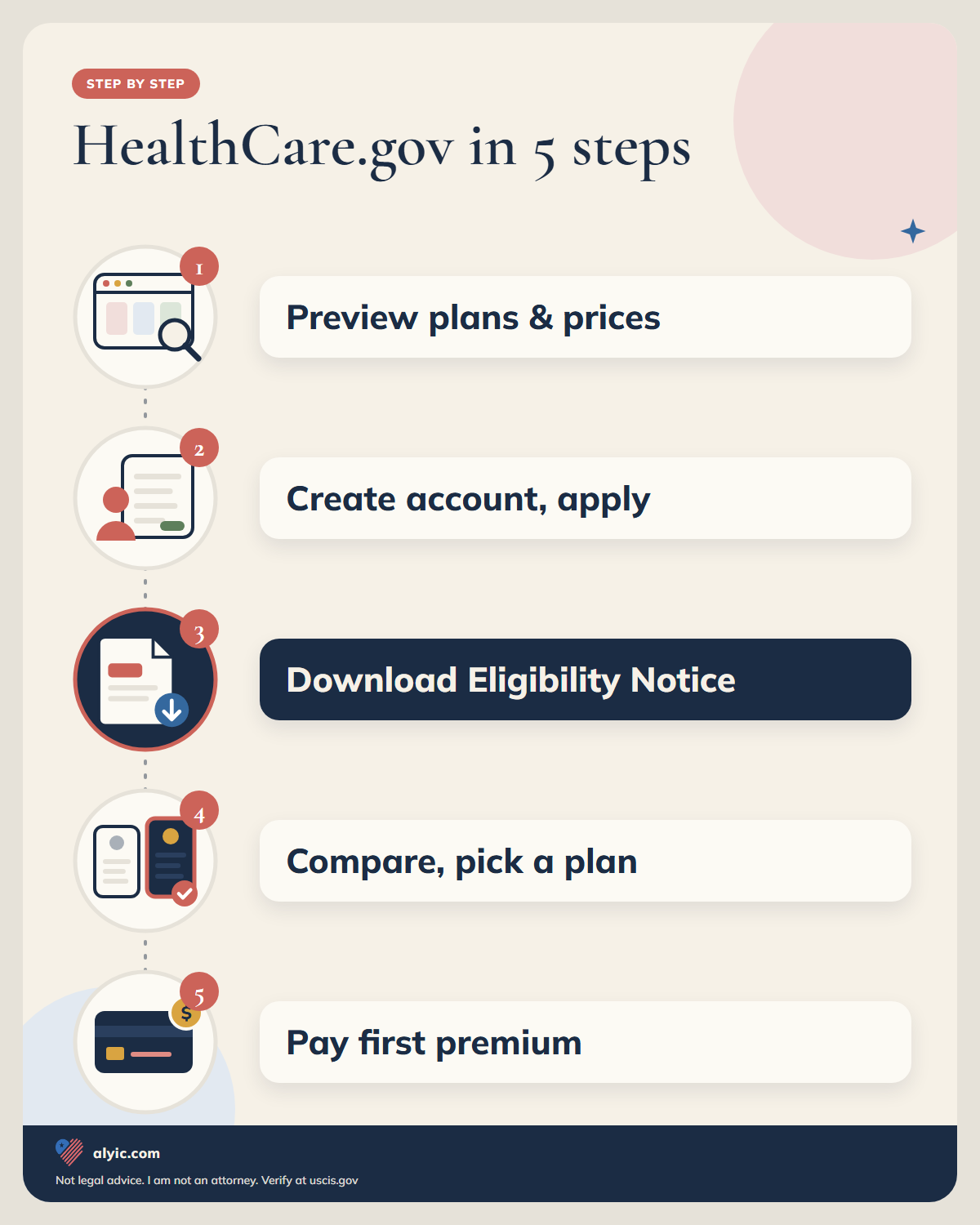
For each plan you consider, open Plan details, use Print (choose "Save as PDF"), and download its Summary of Benefits & Coverage. Write the date on each page. This is what the consular questionnaire asks for: a named plan, an insurer, a monthly price.
You don't have to settle on one plan yet. You can bring the details of two or three plans you are considering: for each, the insurer, the plan name and ID, the metal level, the monthly premium, the deductible and the out-of-pocket maximum. That shows the officer a real plan and a real price, with the final choice to be made once the person can enroll.
In my experience, showing the coverage options available to you is usually enough, and you don't have to pay anything in advance. An embassy may sometimes ask for proof that a monthly premium has been paid; then you pay it. Paying first makes even less sense in a spouse case where the beneficiary can be added to the petitioner's insurance after the wedding or after entering the U.S. Then bring a letter from the employer's HR with the date they can be added, and a copy of the insurance card.
Step 2. Create the account and apply
Once the person who needs coverage lives in the U.S.:
1. Create an account. At healthcare.gov choose Create account. First pick the state you live in: some states have their own Marketplace, and HealthCare.gov sends you there. Then enter your first and last name, email, a password and three security questions, and agree to the terms.
2. Need 2027 coverage? On your account page select the state and press Start application.
3. Setup. The home address and phone. The home address can't be a PO Box.
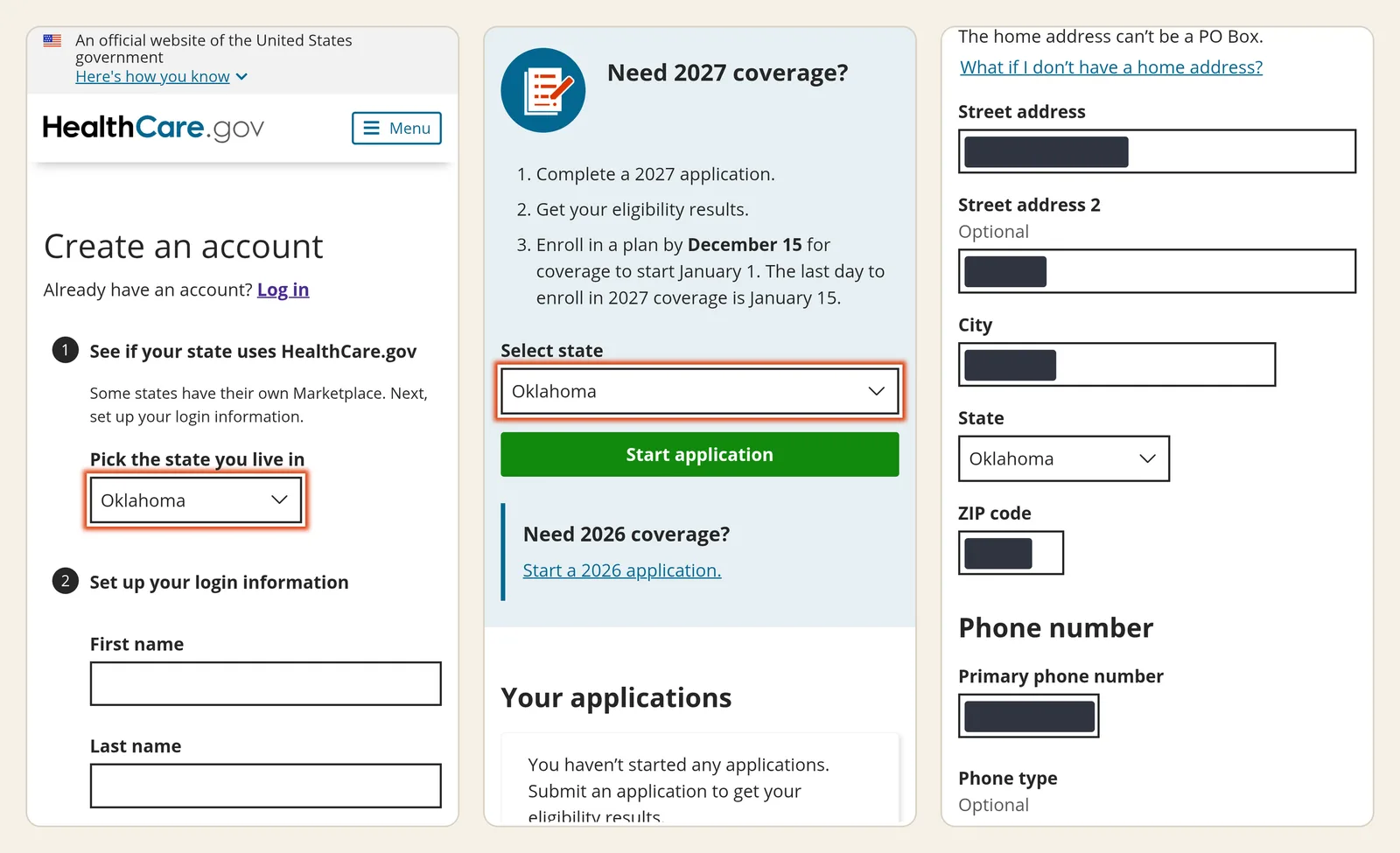
4. Household. List everyone in the household, including K-2 children, and mark who is applying for coverage.
5. Eligible immigration status: answer Yes. This is the answer the coverage depends on. The other choice reads: "I understand that if I don't answer, [the person] won't be able to get Marketplace coverage." The question comes for each person who is not a citizen: answer Yes for the K-1 parent and for every K-2 child. After Yes you can enter a document number, for example the I-94 for a K-1 or K-2 entrant, or choose None of these: the page marks the numbers as optional and says they "can help us confirm" the status faster. Without them the Marketplace asks for documents later (see Step 3).
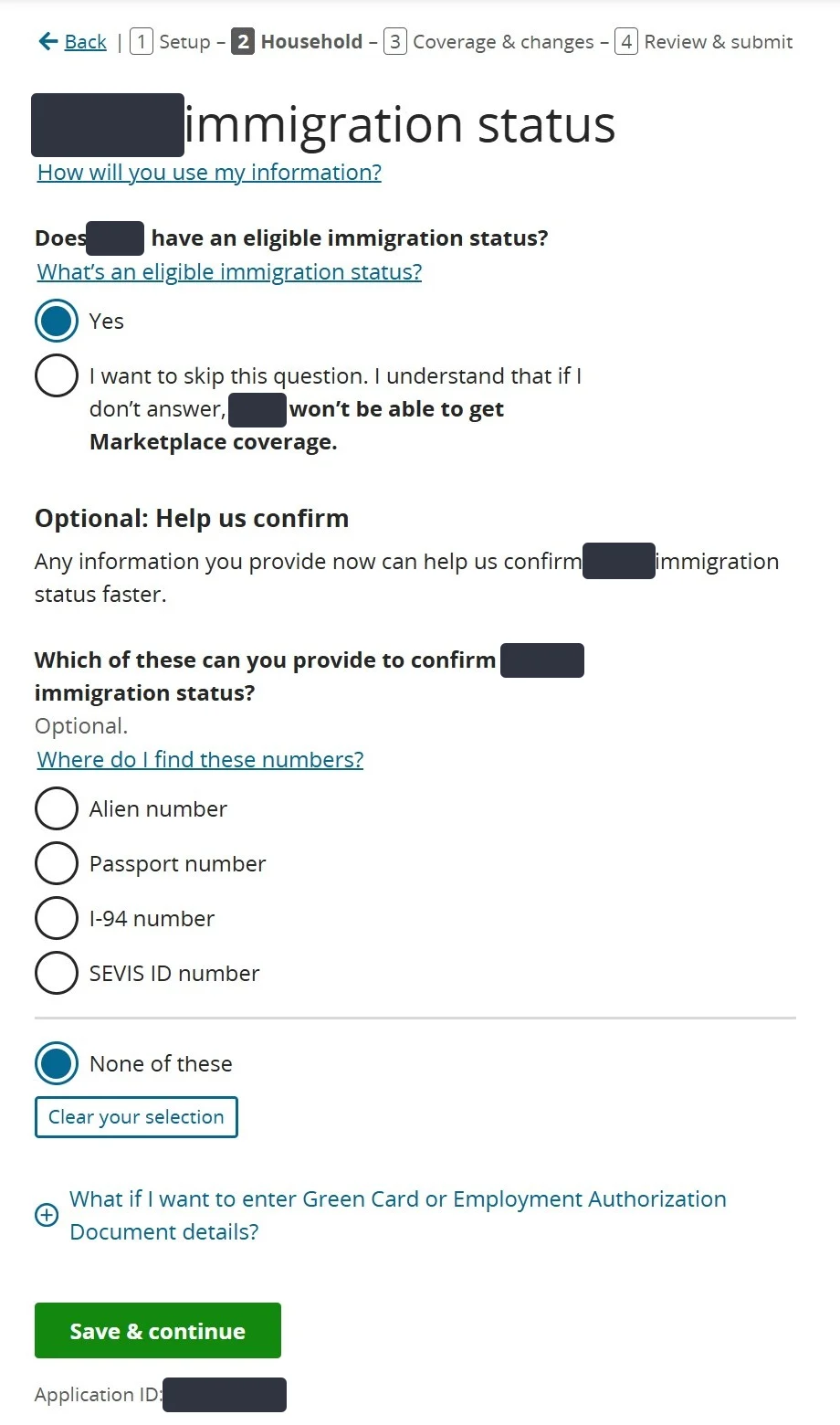
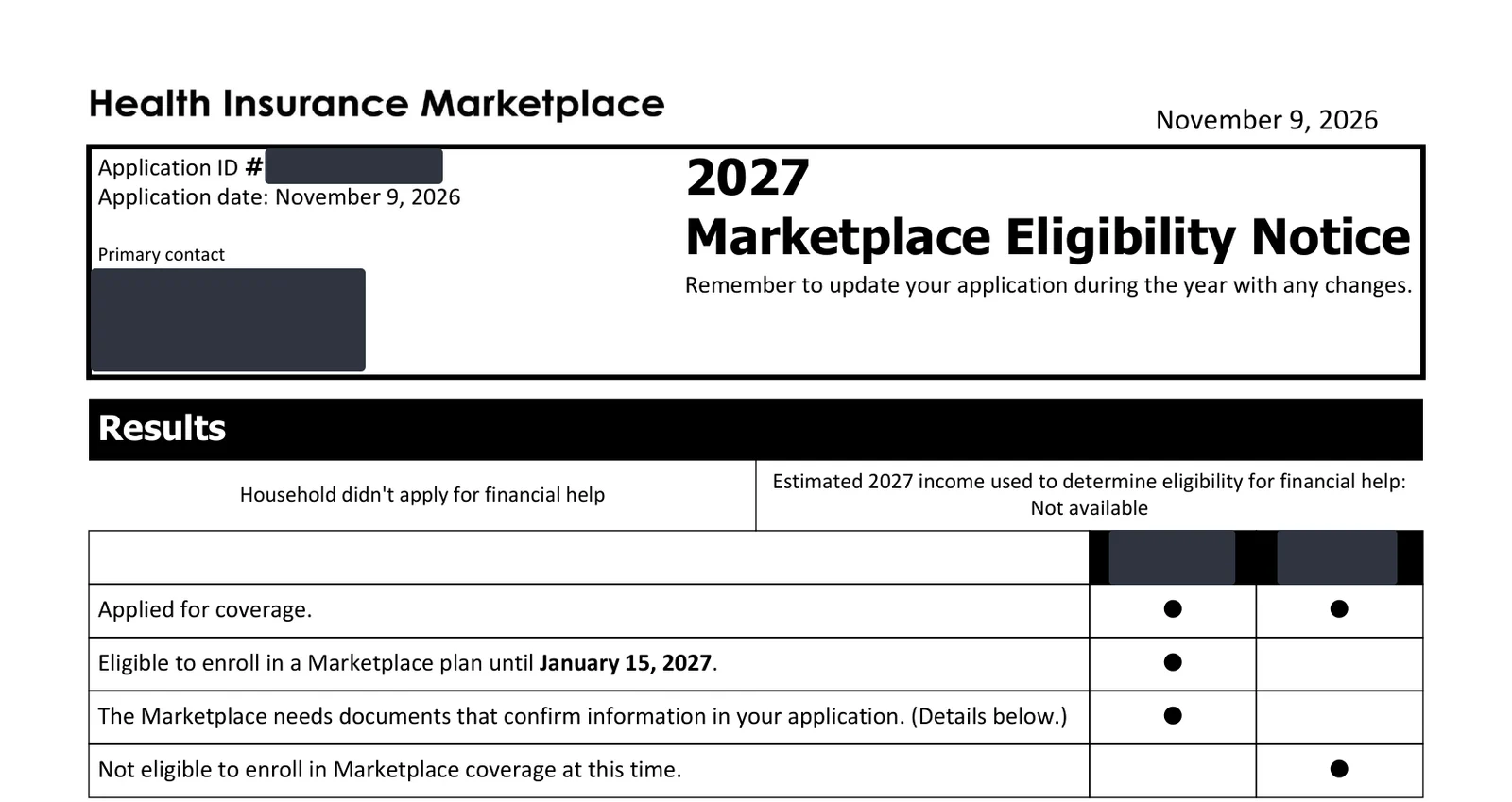
In the application shown, Yes was answered for one family member and not for the other. On the notice the first is eligible to enroll in a Marketplace plan; the second is "Not eligible to enroll in Marketplace coverage at this time."
6. Income. Know before you answer: if it looks like anyone qualifies for Medicaid or CHIP, HealthCare.gov will "securely send your information to your state agency." This now matters for public charge: under the new DHS rule for I-485s filed from September 18, 2026, Medicaid and CHIP count against the applicant, and not only receiving them counts, but also applying for them or being approved, on or after September 18, 2026. Sending your information to the state agency may become such an application. It is not an automatic refusal, but one of the factors. This is the USCIS rule for I-485; consulates follow their own State Department rules. More in Public charge and domicile in 2026.
7. Coverage & changes, then Review & submit. Answer the remaining questions, check every answer, sign and submit. Online, results come right away. Made a mistake? See "Mistakes and changes after you apply" below.
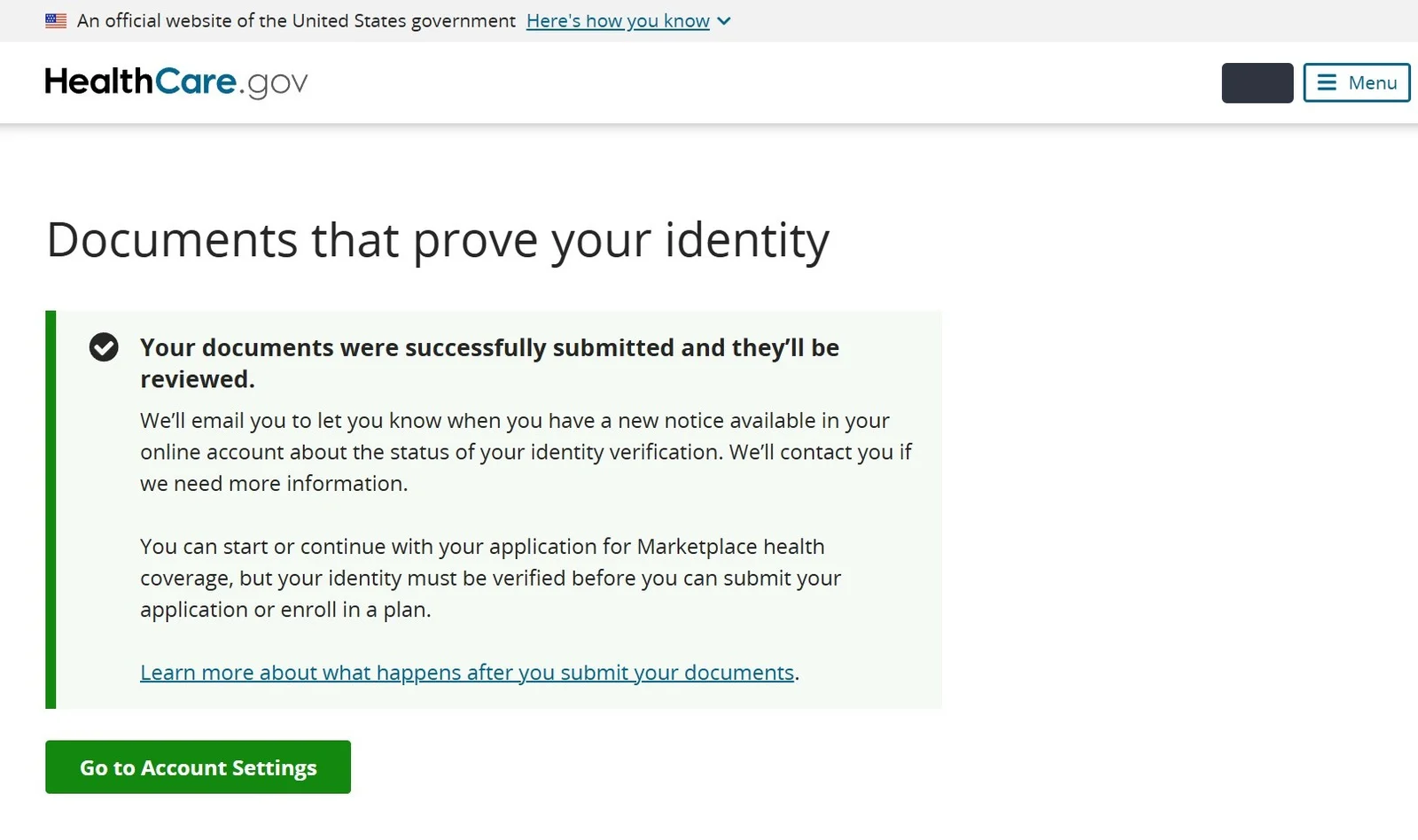
If HealthCare.gov can't confirm your identity
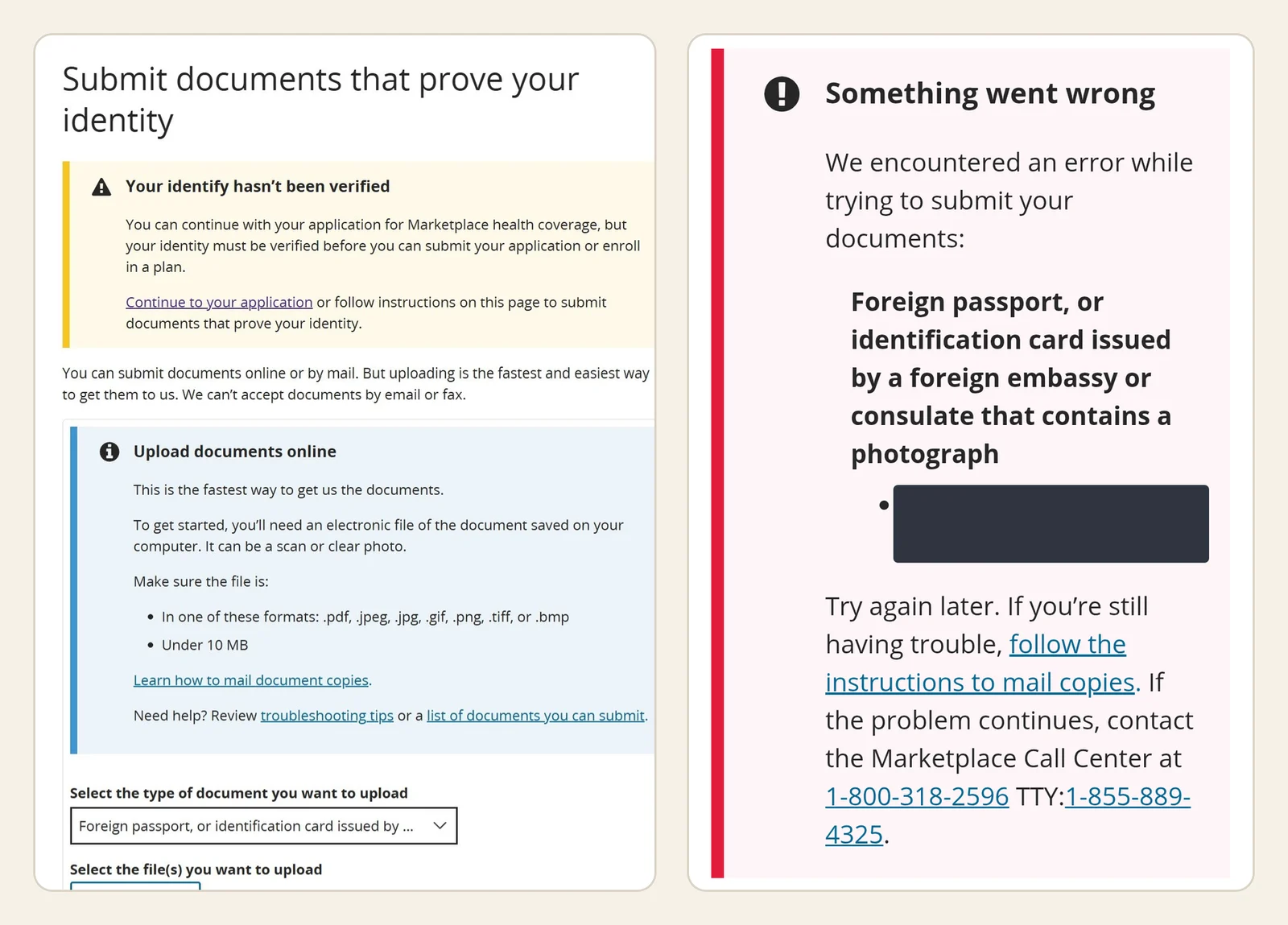
Your identity must be verified "before you can submit your application or enroll in a plan." If the online check can't confirm you, upload a document. In the list choose Foreign passport, or identification card issued by a foreign embassy or consulate that contains a photograph. The file must be .pdf, .jpeg, .jpg, .gif, .png, .tiff or .bmp and under 10 MB. Documents are not accepted by email or fax. Checking the passport can take a few days. HealthCare.gov emails you when a new notice about your identity is in your account, and until then you can't submit the application or enroll.
Upload the passport from a computer, not a phone. In my client's case the upload from a phone ended with "Something went wrong". The same passport uploaded from a computer went through, the identity was confirmed, and within a few days the application was found eligible for coverage. This is my own experience, not an official rule.
Step 3. Download the Eligibility Notice
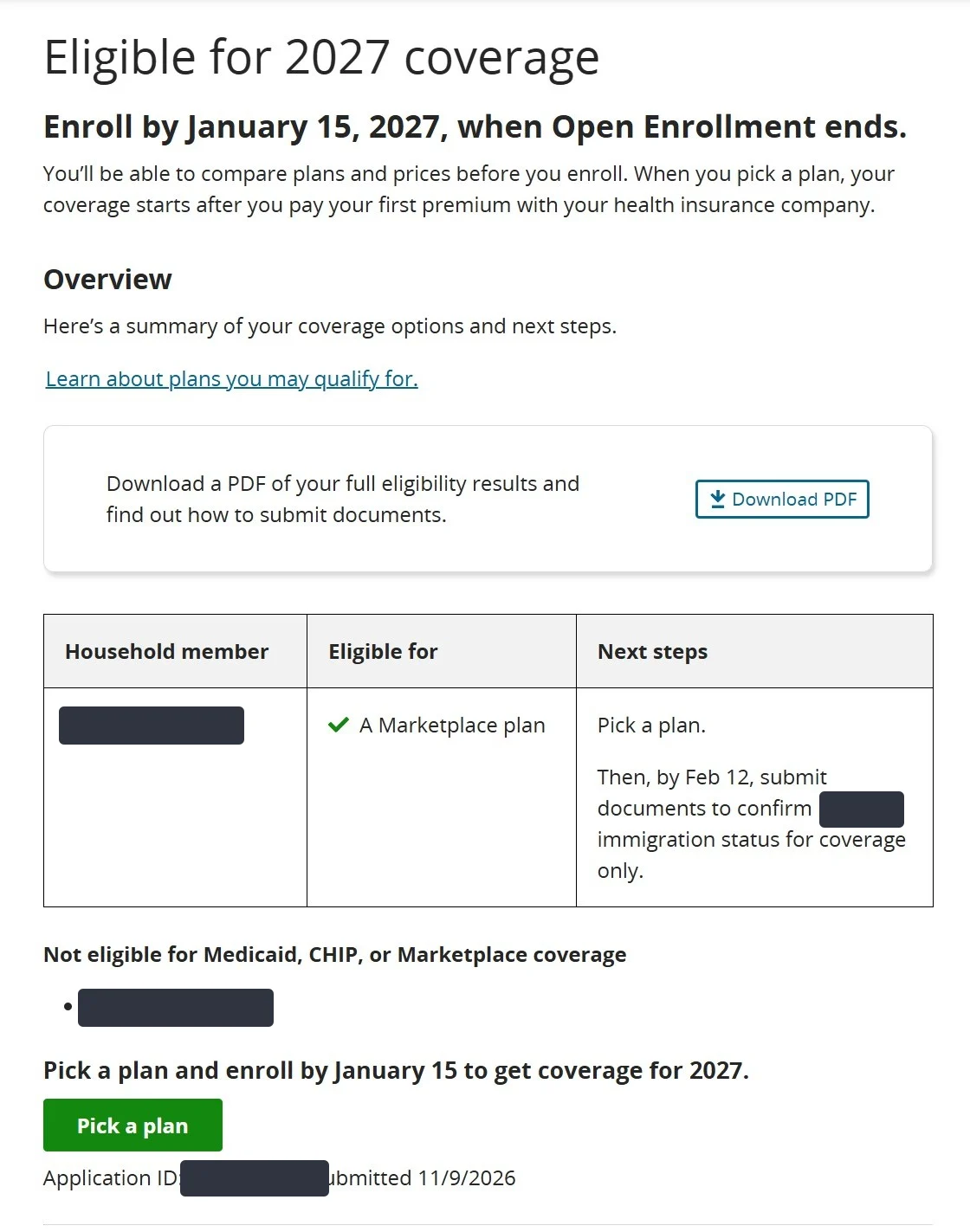
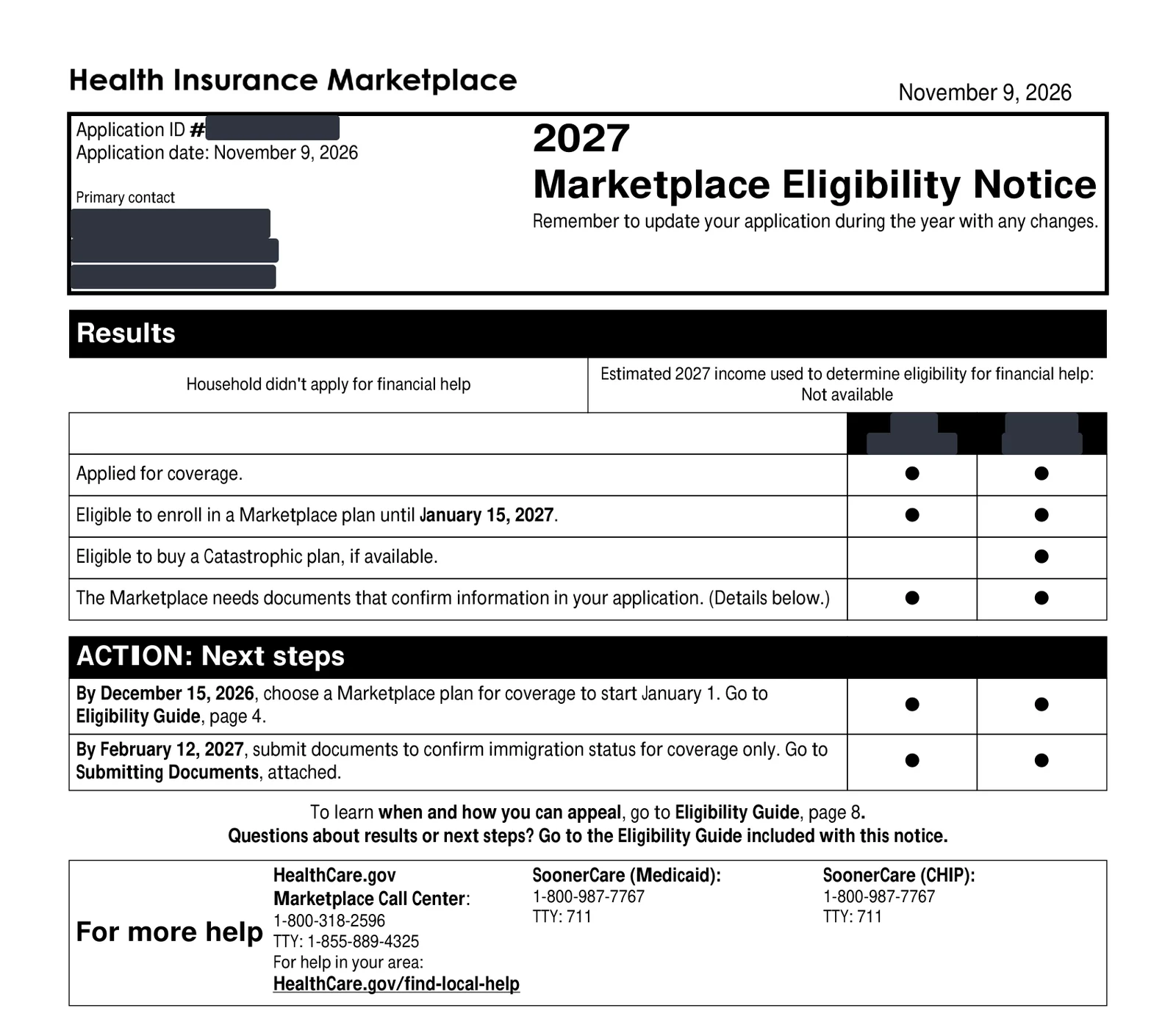
After you submit, you land on the eligibility results ("Eligible for 2027 coverage"). Select Download PDF: that is the Eligibility Notice. Save it. You can open it again any time from Application details in your account.
For each person the notice shows eligibility for a Marketplace plan, premium tax credits, cost-sharing reductions and Medicaid or CHIP, any Special Enrollment Period deadline, documents you must send and by when, coverage start dates, and appeal rights. If it asks for documents to confirm a Special Enrollment Period, you have 30 days after picking a plan to send them, and you cannot use the coverage until they are accepted.
If the Marketplace could not confirm immigration status from the application, the notice gives a date to send documents "for coverage only" (in the case shown, February 12, 2027). Its page Confirm: Immigration Status for Coverage Only says that if your status qualifies, "you can enroll in a plan, but you won't qualify for financial help. You'll pay the full cost of your plan." Most people send a Green Card, an Employment Authorization Card or a foreign passport with immigration documents. Upload them in Application details with Upload documents.
Step 4. Compare plans and save their details
The to-do list asks how much tax credit to apply (if any), tobacco use, your doctors and medicines, then View Plans. On Pick a health plan filter by premium, deductible, plan type and metal level, tick Compare on up to three plans, and open Plan Details. Select this plan, review and signing are only for when you decide to buy a plan (see Step 5). (These are the names in CMS's training; HealthCare.gov sometimes renames a button.)
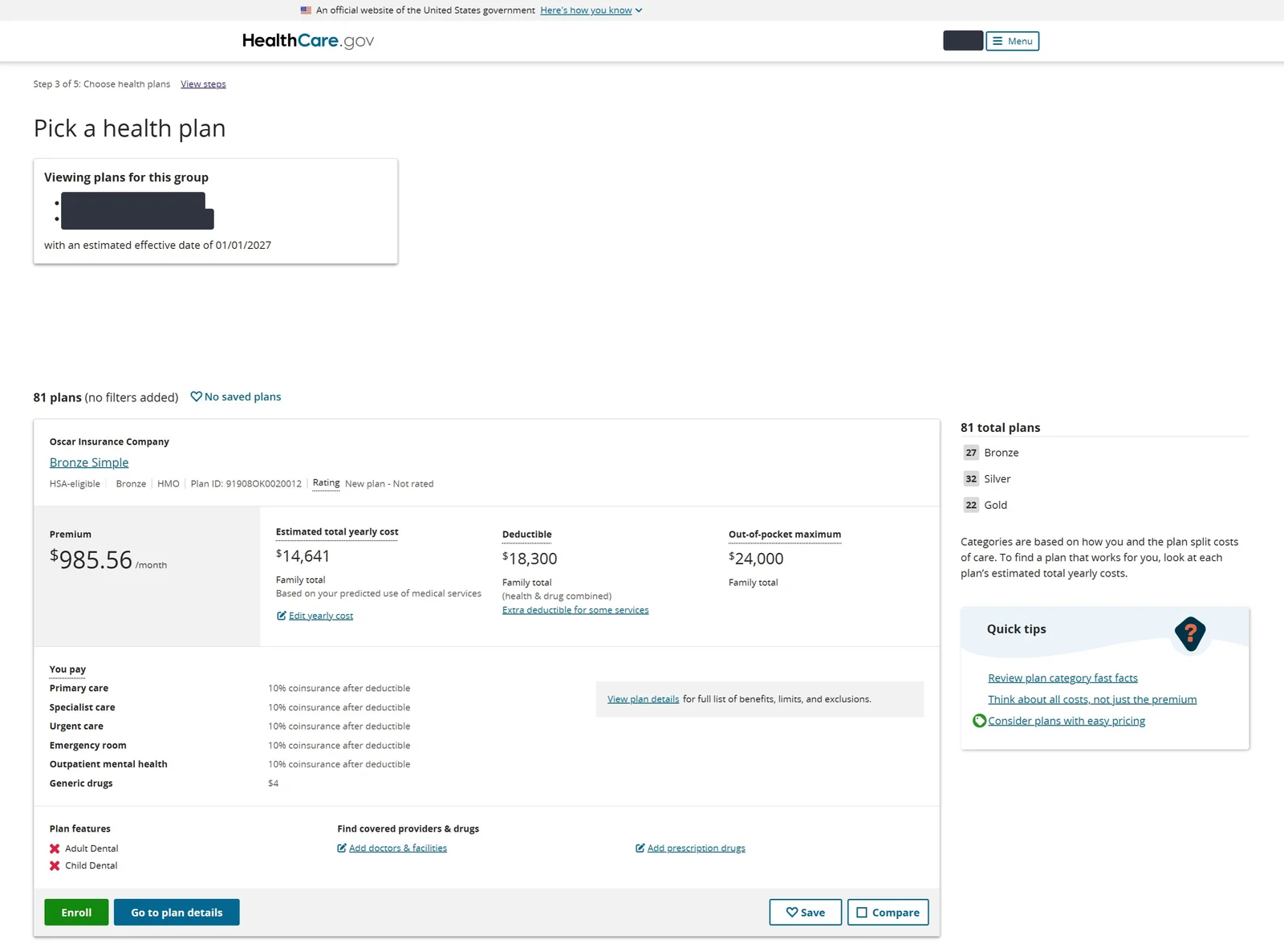
Save the plan details and the Summary of Benefits and Coverage for each plan you are considering (see Step 1).
Step 5. Do you need to pay the first premium?
In my experience, usually not. For the interview it is enough to show the coverage available to you: the notice from Step 3 and the plan details from Step 4. You don't have to enroll or pay for that. You pay the first premium only if the embassy asks for proof that a monthly premium has been paid. In a spouse case where the beneficiary can be added to the petitioner's insurance after the wedding or after entering the U.S., there is usually no reason to buy a Marketplace plan at all (see Step 1). This is my own experience, not an official rule.
If you do enroll, enrollment is finished only when the insurer receives the first month's premium by its due date. Then keep the welcome letter, the ID card and the payment receipt. Coverage dates are under My Plans & Programs.

Mistakes and changes after you apply
If you made a mistake in the application, there are two ways to fix it:
- in Application details, choose Remove my application and start again;
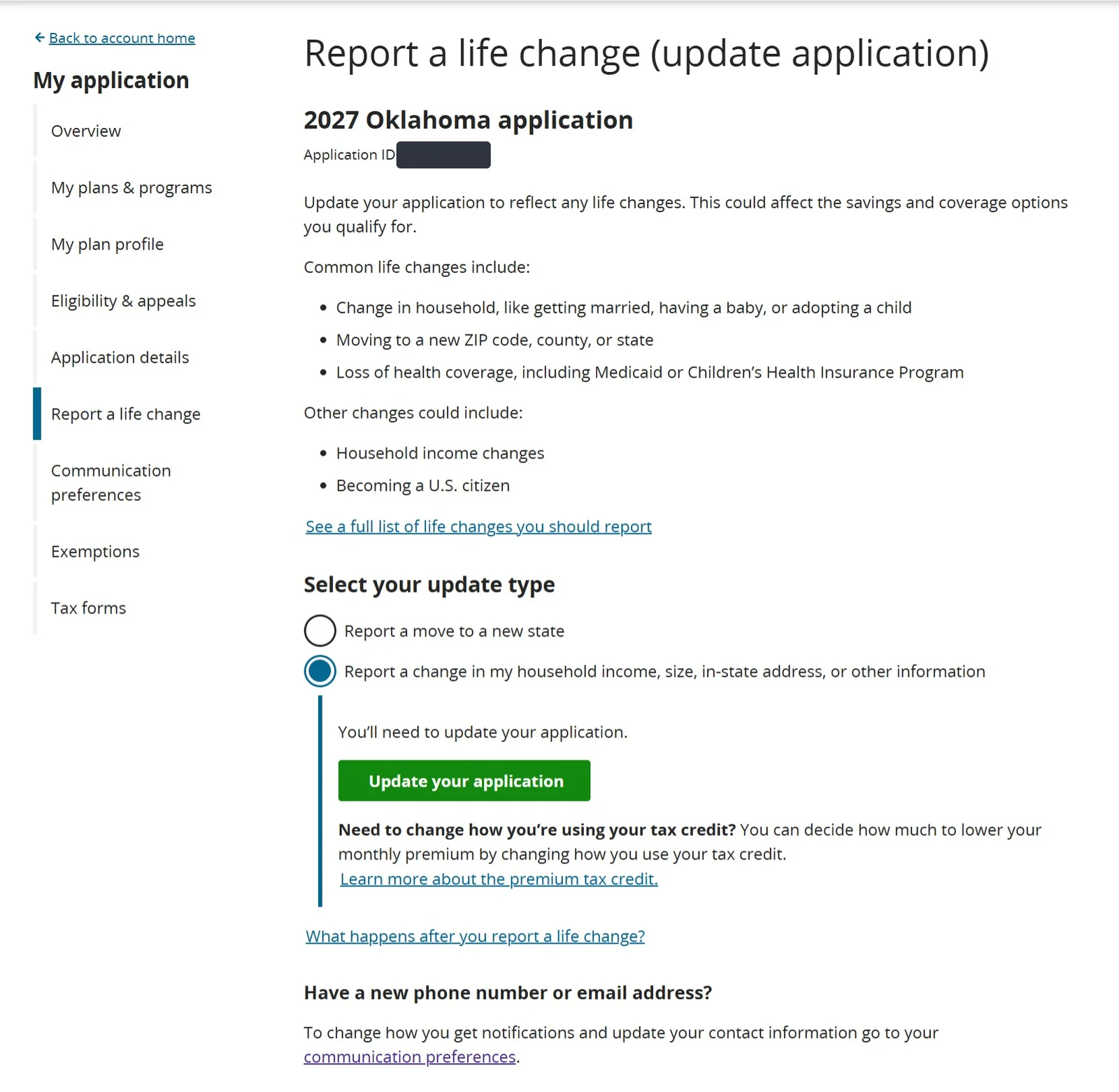
- or open Report a life change, choose Report a change in my household income, size, in-state address, or other information, then Update your application.
The same Report a life change is for real changes later: a wedding, a move, a new baby, a change in income. After a K-1 wedding this is where the marriage goes.
A paid travel medical policy for the first weeks
No form or rule I found requires travel insurance. This is my own advice, and I recommend it in every case: K-1 and K-2, CR-1/IR-1, F2A and others, whether or not the person is eligible for a Marketplace plan. Especially if you are not going to pay the monthly premiums (see Step 5): then the person has no coverage at all in the first weeks in the U.S. There are usually some weeks between landing and the first day of U.S. coverage: a Marketplace plan starts on the first of the month after you pick it at the earliest, and adding a spouse to employer insurance takes time too. Have a paid policy for each person, children included, covering the U.S. from the flight until U.S. coverage starts, and keep proof of payment. If the officer asks, it shows your plan for those weeks.
Local insurers in Ukraine, Russia, Kazakhstan and elsewhere sell this kind of policy. An example for a beneficiary living in Russia: T-Bank sells travel insurance from АО «Т-Страхование» online - enter the country and dates, pay by card, and the policy comes by email. This is an example, not an endorsement. The price depends on the country, dates and number of people, so I do not quote one.
Keep the policy PDF and the bank receipt.
What goes wrong
- Telling the officer "we will buy insurance after arrival" with no plan, insurer or price.
- A quote without the date, ZIP code or monthly premium on it.
- Missing the 60-day window after the move or the wedding.
- Uploading the passport from a phone and stopping at the error. Try a computer.
- Answering Yes on immigration status for the K-1 parent but not for the K-2 child: the child comes back not eligible.
- A travel policy that ends on day 30 while U.S. coverage starts on day 45.
Official pages
- HealthCare.gov: Preview plans & prices
- HealthCare.gov: getting a Marketplace plan in 4 steps
- HealthCare.gov: dates and deadlines
- HealthCare.gov: immigration statuses
- HealthCare.gov: submitting documents
- HealthCare.gov: Special Enrollment Periods
- CMS: the Eligibility Notice
- Т-Страхование: travel insurance and its rules
To prepare your answers for the interview, use my free statement of plans and resources.
This article is general information, not legal advice. I am not an attorney: I prepare immigration documents. If you would like my help preparing your case, contact me. I'm always happy to help!