


Checked October 11, 2026. For families going through NVC and a consular interview for an immigrant visa.
You got through NVC, your documents were accepted, and the sponsor's income is above the minimum. The money question feels settled. Then at the interview the officer asks about something else entirely: benefits your American spouse received years ago, health insurance for your first months in the U.S., your own savings, where the petitioner really lives. And then 212(a)(4), 221(g) or the unfamiliar word "domicile" shows up on your paperwork.
What happened? Usually three different questions are tangled together: whether the I-864 is in order, whether the domicile requirement is met, and how the officer assesses the immigrant's future financial self-sufficiency, which is public charge. In 2026 the DHS rules changed, and consulates started asking more detailed questions about money. These are not the same thing, and one cannot simply be carried over to the other. Below I go through it in order: what is confirmed by documents, what applicants themselves report, and how to tell an income question from a domicile problem. DHS rule · State Department guidance · Sample questionnaires
General information, not legal advice. I am not an attorney; I provide document-preparation services.
What to know first
- Being DQ'd at NVC is not visa approval. NVC checks that the documents are there. The consular officer decides on the visa.
- A joint sponsor can cover an income shortfall, but not the petitioner's domicile, when the petitioner's own I-864 is required.
- Public charge looks ahead. You don't need a history of benefits for the question to come up.
- The new DHS rule has applied since September 18, 2026, but only within its own scope. By its own terms it does not govern consular visa decisions.
- A question about SNAP, WIC or insurance doesn't mean that was the reason for a refusal. To know the reason, you need the refusal ground and the case file. DOS: I-864 · DHS: final rule · Consular questionnaires
Three checks that get mixed up
I-864, Affidavit of Support is the sponsor's financial obligation under the law. The officer checks the right form, signatures, the sponsor's status, how the household is counted, income and assets. In most family cases the petitioner files their own I-864 even when there is a joint sponsor. There are exceptions, but only in certain categories. DOS: I-864
Domicile is where the sponsor actually lives and intends to keep living. A U.S. passport and a U.S. mailing address don't prove it on their own. Sponsorship rules
Public charge under INA 212(a)(4) is an assessment of how likely the immigrant is to depend on government support. The law requires the officer to consider age, health, family status, assets and finances, education and skills, and, where it applies, the required I-864. One bank balance or one benefit can't measure that. DOS: public charge · 9 FAM 302.8
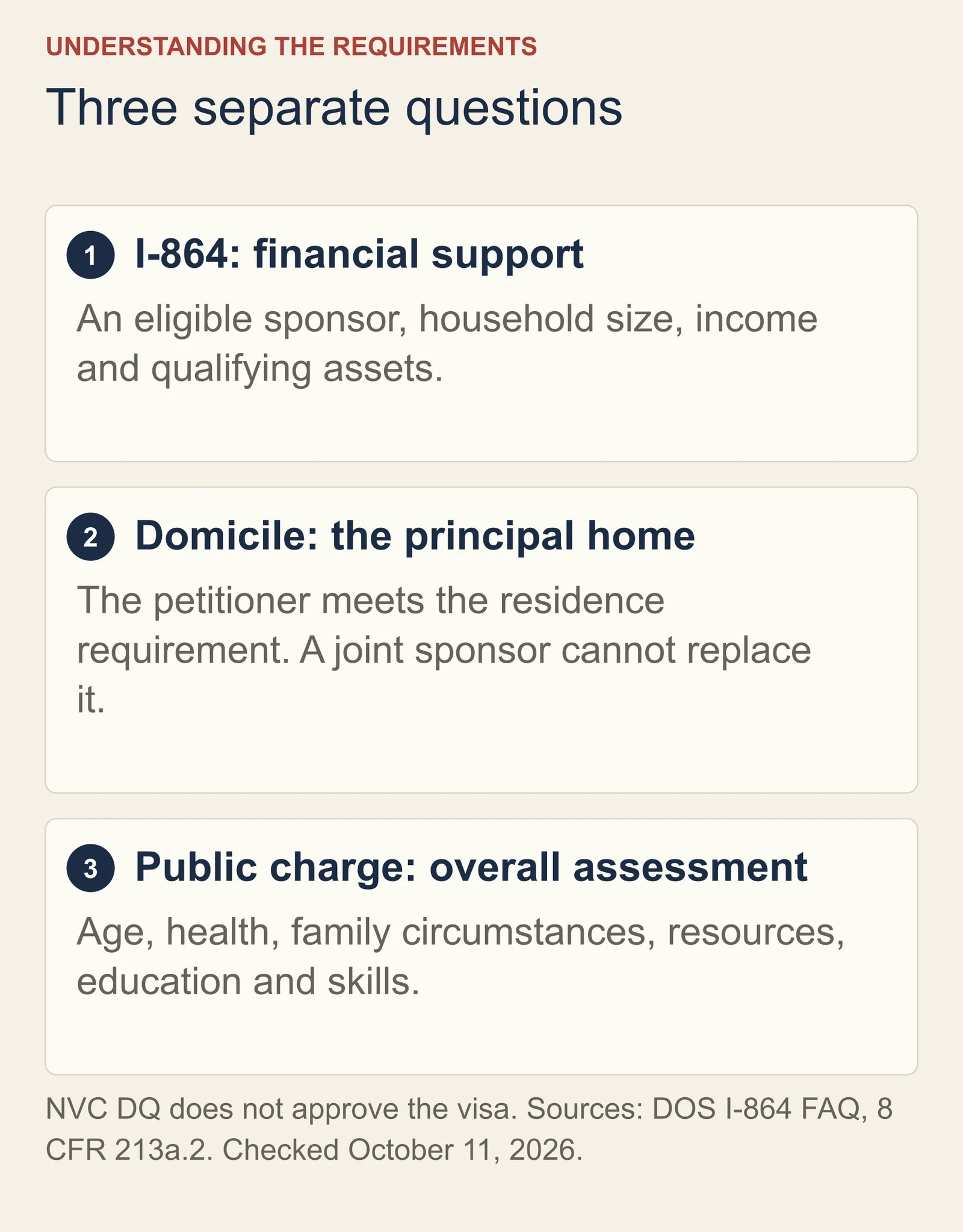
The diagram shows different requirements, not the odds of a refusal. Sources: DOS* and [8 CFR 213a.2](https://www.ecfr.gov/current/title-8/chapter-I/subchapter-B/part-213a/section-213a.2).*
That is why a family can have a very well-off joint sponsor and still be asked about the petitioner's domicile. Or have a perfectly good I-864 and still get questions about medical costs and where the money will come from. The State Department itself says that a properly completed I-864 is not the only thing considered in public charge. DOS: financial support
What applicants are reporting
In recent weeks the same picture keeps coming up on Reddit, in r/i130_75CountryPause and r/NationalVisaCenter. These are applicants' own accounts: they can't be verified and there is no official confirmation. But the patterns are clear.
- It's not only spouse visas. The accounts include CR1 and IR1, but also the family F categories: F1 (unmarried adult sons and daughters of U.S. citizens) and F3 (married sons and daughters of U.S. citizens). The F3 stories are the domicile ones: the petitioner had lived abroad for years, and a joint sponsor didn't fix that.
- The questions go well beyond the I-864. People are asked about the benefits of the petitioner or their family, sometimes from many years ago, about the applicant's own savings, about insurance for the first months and about what work the applicant will do.
- Second interviews and 221(g). Many describe a second interview after a long wait, and a 221(g) with a list of extra documents.
- Petitioners who lived abroad for a long time get domicile questions, even when the joint sponsor earns a lot.
- There is good news too. People report visas issued after a detailed second interview, and visas issued with no new interview at all: the consulate simply asked for the passport.
Many people tie a refusal to one reason: "because of my wife's old WIC", "because my savings are small". But a story like that can't tell you the officer's reasoning. And these reports can't give a refusal rate: nobody knows how many cases went through without trouble, and people with good news post far less. So there is no "half get refused" here, and no ranking of "dangerous" consulates.
What consulates actually ask
On October 9, 2026, AILA published sample questions from three posts: France, London and Kingston. That is far more reliable than a retelling of someone else's interview. But remember: the questionnaires show what is asked, not what leads to a refusal. AILA publication · Original documents, 7 pages
- In all three samples: where the applicant will live; work, training and qualifications; health insurance or paying for treatment.
- In London and Kingston: assets and debts.
- Only in Kingston (IR2 sample): current and past public assistance for the petitioner and the applicant, plus questions about the joint sponsor.
A topic missing from a sample doesn't mean it is never asked. The comparison describes only the published documents. Source
In the Kingston sample, questions 17-19 cover current and past assistance and long-term institutional care at government expense. WIC, SNAP and food assistance are named outright. Question 18 also asks you to explain what has changed since the family relied on assistance. Question 20 is about the joint sponsor: how they are related, how long they've known you, where they live, whether they've sponsored anyone before and whether they've received assistance. Questionnaire, pp. 6-7
Three details that are easy to miss:
- Household means the household, not only relatives.
- Question 9 is about everyone the petitioner actually supports, including relatives and friends. It doesn't mean each of them now has to be counted in the household size on Form I-864.
- Question 12 asks for salary after taxes. That doesn't change how income is counted on the I-864 itself. Questionnaire, pp. 5-6
Paris and London also ask about any license or training needed for work, who will support the family in the meantime, and exactly what insurance will cost. "We'll buy insurance after we arrive" leaves the main questions open: which plan, when coverage starts and what it costs. And the email address for advance materials in the London sample is London's own, not a general address for every embassy. Questionnaires, pp. 1-3
Warsaw and Almaty: what we know
There are no published questionnaires for Warsaw or Almaty, but some things are known, and they sit well next to the AILA samples.
Almaty. Before a re-interview, the U.S. Embassy in Kazakhstan sends applicants a letter with a list of documents (October 2026). It's a list, not a questionnaire, but the topics are the same and in places broader: a personal credit report, a statement on whether you received targeted social assistance, a valuation of all your property with a translation, bank and pension statements, a plan for health insurance in the U.S., job offers or a work plan, plus an updated medical exam and the I-864 (and I-864A if a household member's income is used). Everything must be brought to the interview and uploaded to CEAC. Details in the article on documents for a re-interview.
Warsaw. Here there are only applicant reports, with no official confirmation. In a re-interview letter an IR-1 applicant received in September 2026, the immigrant visa unit asked for the petitioner's tax documents for the last year, and from the applicant: education documents, proof of assets and finances, bank statements and employment plans in the U.S. At the interviews themselves, applicants (including in Warsaw) report questions about the sponsor's job and salary, property, savings and debts, child support, whether the sponsor ever received public assistance, whether they have health insurance and will add the applicant to it, and, in a lot of detail, the applicant's own plan for work or study. More in the article on interview questions.
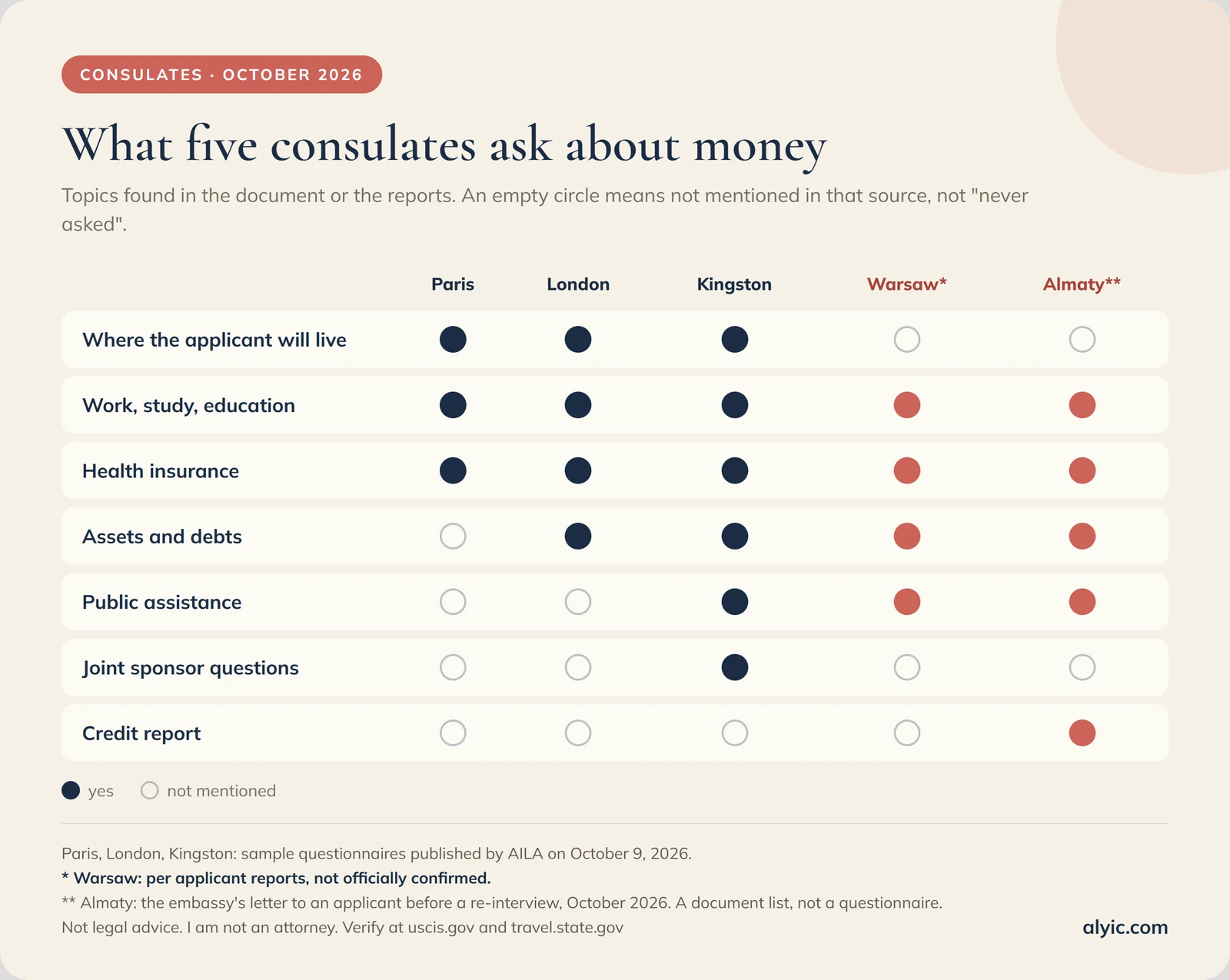
What the comparison shows: the topics are almost the same everywhere - work, insurance and the family's money. Kazakhstan goes furthest on documents: only there are applicants asked for a credit report and a social assistance statement from their own country. If your interview is in Warsaw or another country, prepare for the same topics, but what is required is only what your own embassy's letter lists.
What the new DHS rule counts
The new DHS rule applies to I-485 applications mailed (by postmark) or filed online on or after September 18, 2026, and to applications for admission where this ground applies. The date of the I-130, the DQ or the consular interview is not the I-485 filing date. DHS: the rule of July 20, 2026
Any government means-tested benefit counts, meaning a benefit you qualify for because your income or assets are below a set level. It doesn't matter who funds it: the federal government, a state, a city, a territory or a tribe. The rule has no closed list of programs, but it names:
- Cash assistance for income maintenance: SSI, TANF, state or local cash assistance.
- SNAP (food stamps) and WIC.
- Medicaid, including ordinary health coverage, and CHIP, as well as state means-tested health programs and health care for pregnant women.
- Means-tested housing assistance: any housing the government provides, pays for or subsidizes, for example Section 8 vouchers and public housing.
- Means-tested children's programs, when the applicant child receives them: child care subsidies, Head Start, early intervention.
- State, local or tribal means-tested help, including help with college.
- Long-term institutional care at government expense.
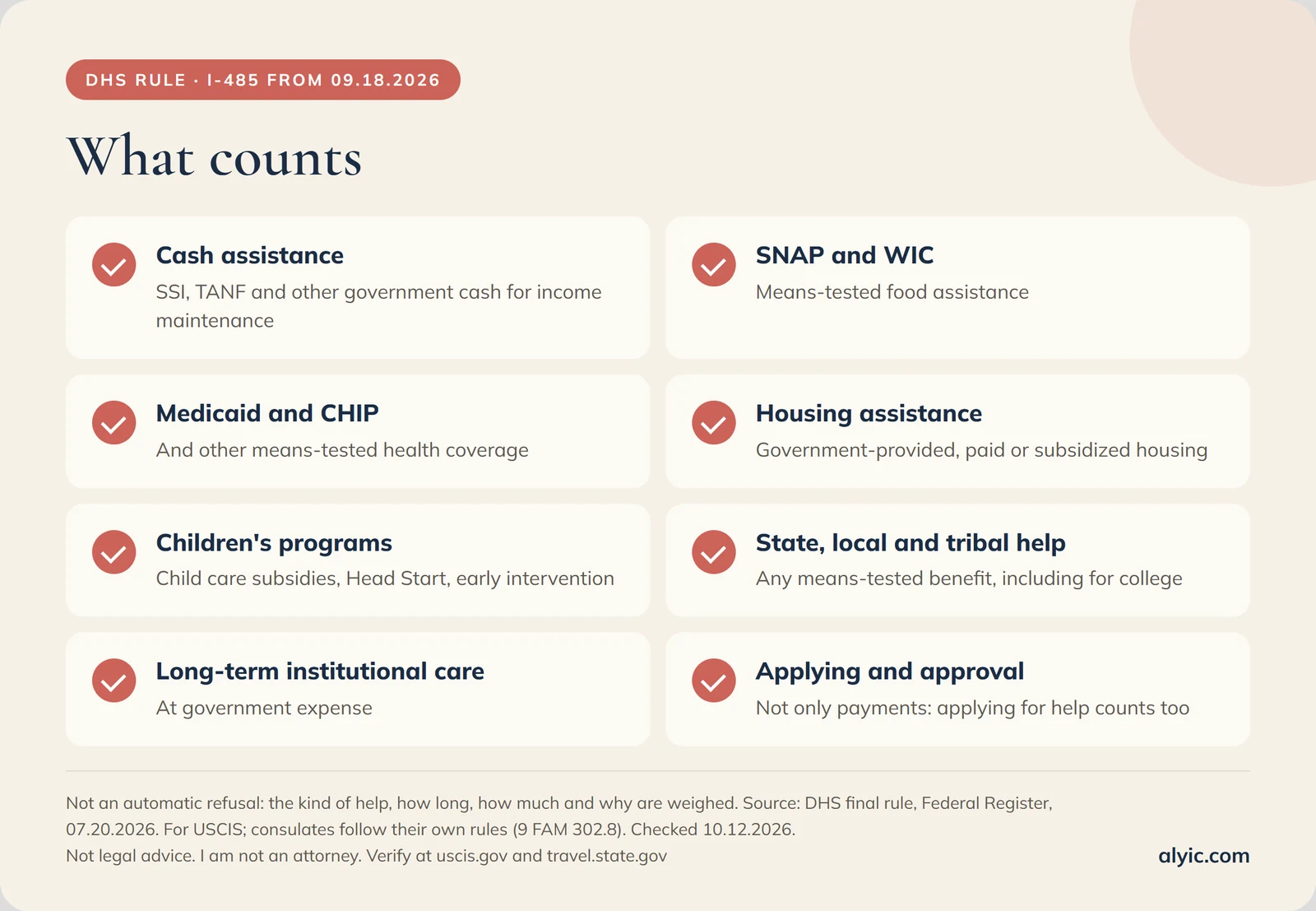
How it works:
- Not only the help itself. Applying for help and being approved count too, even before any payment.
- Dates. Non-cash help (SNAP, Medicaid, housing and the rest) counts if it was applied for, approved or received on or after September 18, 2026. Cash assistance for income maintenance and long-term institutional care count whatever the date.
- It's the applicant's own help. Family members' benefits count through the applicant's finances: if a family member the applicant must support receives help because the applicant's income is low, or if a relative's benefits are what the applicant actually lives on.
- It's not an automatic refusal. Help is one circumstance in the overall assessment. DHS looks at the kind of help, how recent, how long, how much, why, and whether that reason still applies.
- The I-485 must list any means-tested benefit received from September 18, 2026.
Source: the DHS rule, Federal Register, July 20, 2026.
This is a USCIS rule, not a consular one. When issuing visas, consulates follow the State Department's rules (9 FAM 302.8), and this list can't be carried over to them automatically.
Domicile: why an address and a wealthy joint sponsor may not be enough
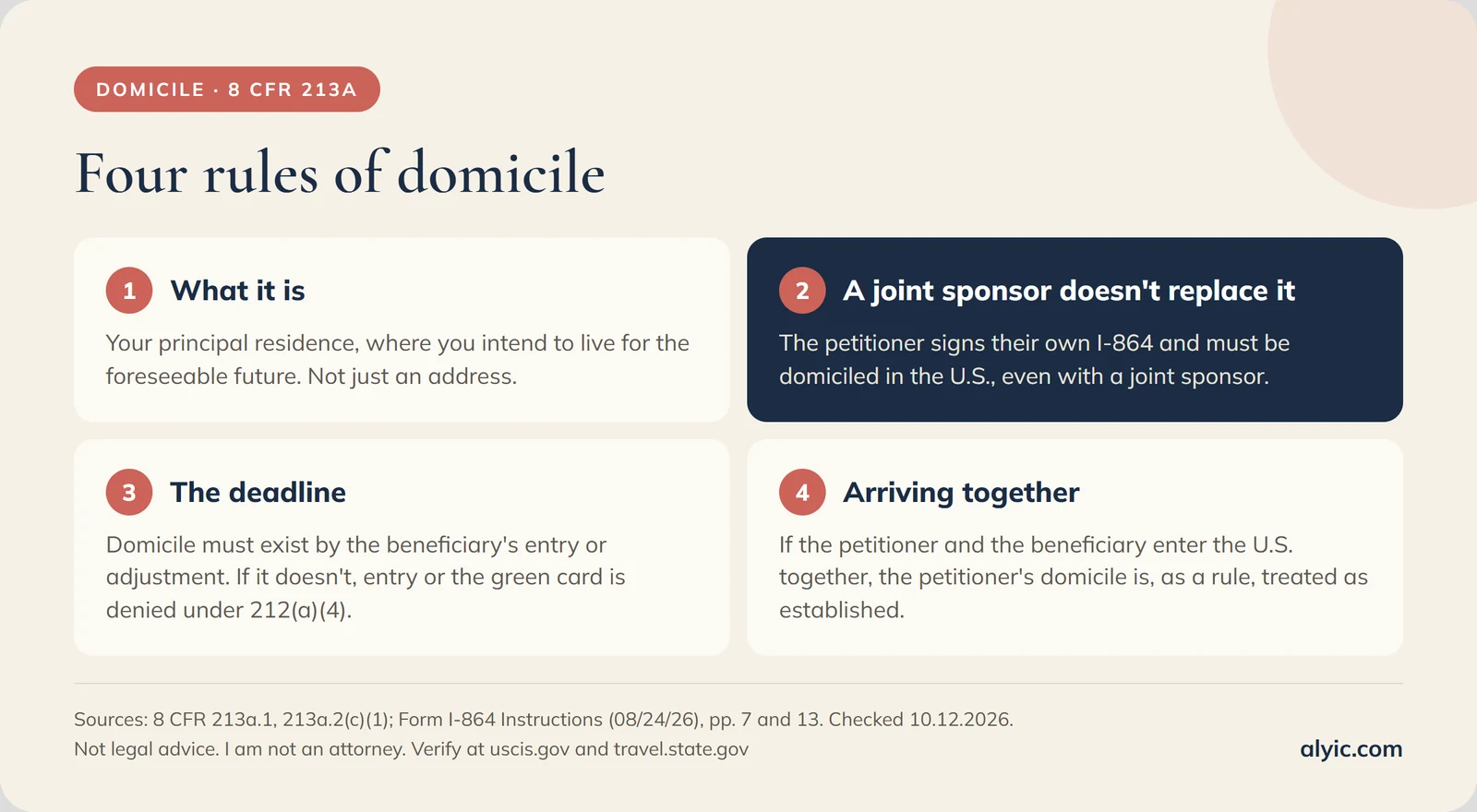
Domicile is where the sponsor actually lives and intends to keep living. For the I-864, the sponsor must be domiciled in the U.S. (including the territories the rules list). If the petitioner lives abroad, the State Department describes several ways to show the requirement is met. DOS: domicile · 8 CFR 213a.2
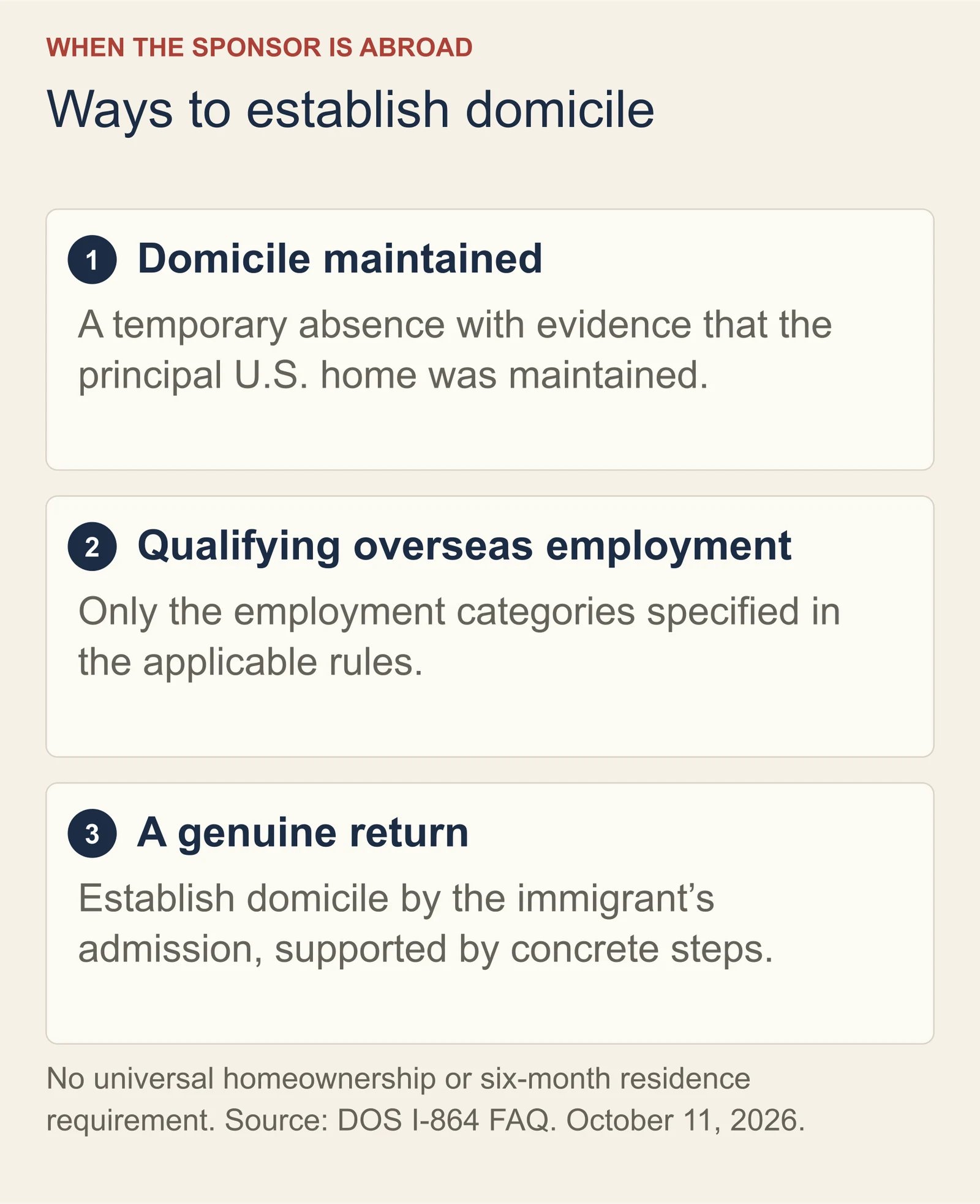
Domicile kept, the absence is temporary. The documents and the explanation have to tell one story: why the absence is temporary, what ties and housing in the U.S. remain, where life is really centered. A bank account or voter registration helps, but one such document doesn't outweigh everything else.
Work abroad in a special category. The rules list special categories: certain government, research, commercial, international or religious work. Ordinary work for a foreign employer doesn't count.
Domicile reestablished before the immigrant enters. What matters here is real steps: housing, a job or a job search, moving money, school for the children, ending a job or lease abroad, the move itself. The petitioner can arrive before the immigrant or together. A promise without action may not be enough. Official explanations and examples
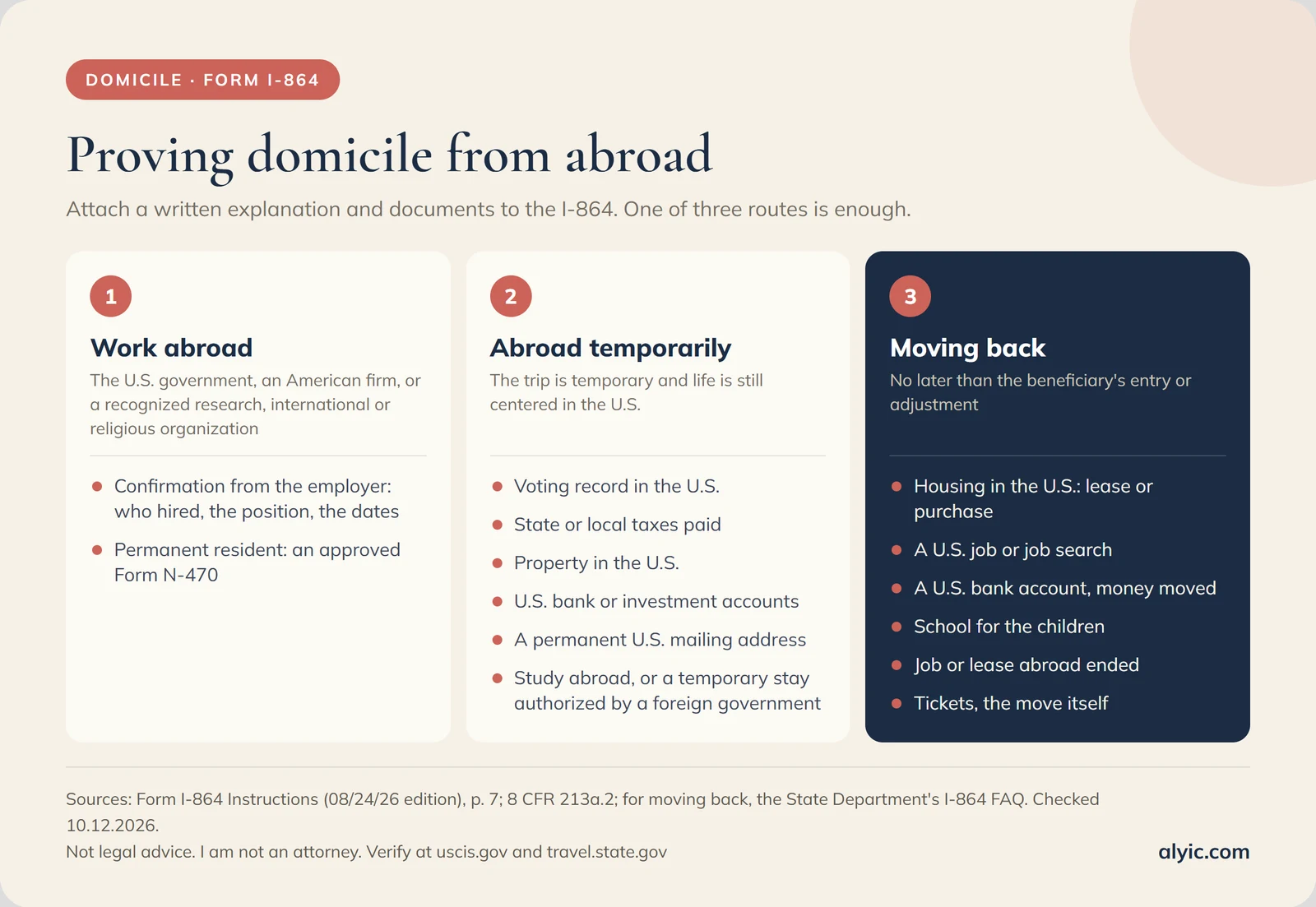
There is no rule that you must "buy a house" or "live in the U.S. for exactly three or six months". You can rent, or really live with relatives. But a short visit while home and work stay abroad proves less than a real move. The officer looks at what the evidence shows, not how many letters there are. DOS
When the petitioner's I-864 is required, a joint sponsor doesn't replace the petitioner's domicile. So a joint sponsor earning hundreds of thousands of dollars and a domicile problem with the main sponsor don't contradict each other. And this isn't new in 2026: petitioners living abroad were asked about domicile before too. DOS
Income and household size: the I-864 minimum
For most I-864 cases the minimum is 125% of the federal poverty guidelines. For certain sponsors on active military duty filing for a spouse or child, it's 100%. Alaska and Hawaii have their own figures. Below are the 2026 figures for the 48 contiguous states and D.C. I-864 rules · HHS table
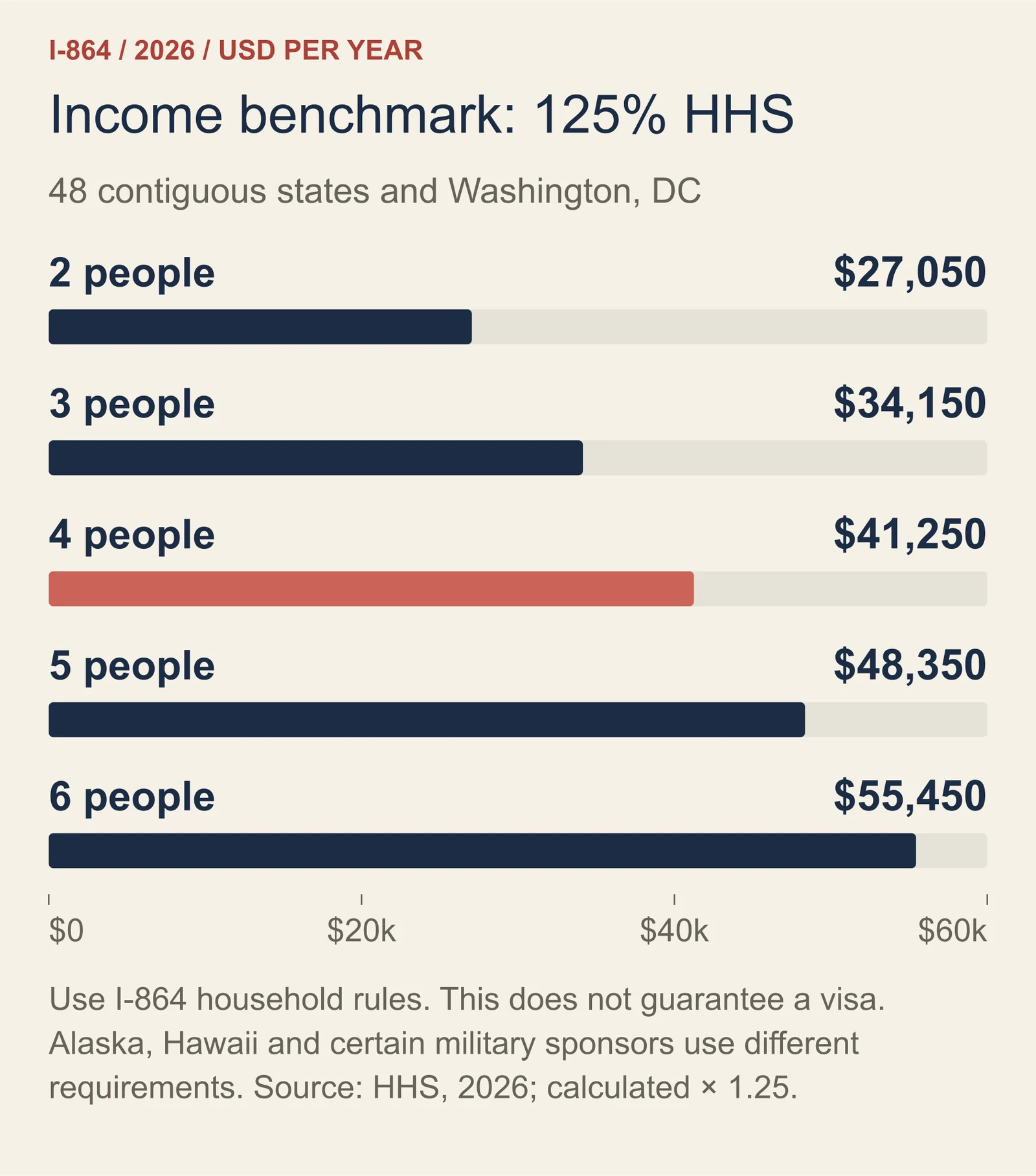
- 2 people: 100% - $21,640, 125% - $27,050
- 3 people: 100% - $27,320, 125% - $34,150
- 4 people: 100% - $33,000, 125% - $41,250
- 5 people: 100% - $38,680, 125% - $48,350
- 6 people: 100% - $44,360, 125% - $55,450
Source for the base figures: HHS. The 125% figure is the 100% figure times 1.25. It's a benchmark for the form, not a guarantee of a visa.
Household size isn't simply the number of people moving or living at one address. It counts the spouse, dependents, sponsored immigrants and anyone the sponsor still has another I-864 obligation for, without counting anyone twice. A joint sponsor has to qualify for their own household plus the people they sponsor. Two short incomes from two independent sponsors don't add up; a household member's income counts through a separate route, Form I-864A. DOS: household and sponsorship
A tax return shows what the sponsor earned before; separate proof of current earnings and that they will continue may be needed. A salary abroad that ends with the move, or a business's gross receipts, is not the same as steady personal income. And the questionnaire's after-tax salary question doesn't change the I-864 rules. DOS · Kingston questionnaire
And don't rush to redo an older I-864 just because a new year started: the State Department has its own rules tied to the form's filing date, and the consulate will ask for updated financial documents if it needs them. DOS: how long an I-864 stays valid
What 221(g) and 212(a)(4) mean
221(g) is a legal refusal at that stage. It is often about missing documents or administrative processing, and in many cases it can be overcome by meeting the requirements. Treating every 221(g) as the end of the case is wrong, but "it isn't a refusal at all" isn't accurate either. DOS: visa denials
212(a)(4) is the public charge ground. In a family case it can concern the overall financial assessment or a required I-864 that doesn't meet the requirements, including the requirements for the sponsor. It doesn't mean someone received a "forbidden" benefit. One notice can cite several grounds at once. DOS · I-864 rules
Refused in CEAC doesn't tell you which document is needed. Start with the written notice: which sections of law it cites and what exactly the consulate is asking for.
How to prepare documents for the interview or after a request
It's easiest to sort documents by the question they answer. This is a general scheme, not one required package for everyone.
- Who the sponsor is and how the household is counted: I-864 or I-864A, proof of status, a household count with no one counted twice, other ongoing obligations.
- What income there is now: tax documents, current information from the employer, payments, self-employment records and proof the income will continue after the move.
- Where the petitioner's domicile is: an explanation of a temporary absence or return, housing, work, real moving steps, dates that don't contradict each other.
- How the family will live after entry: housing, the period of job search or licensing, who will help in the meantime, a specific insurance plan and its price.
- Which assistance was asked about: the exact program name, the recipient, who funds it, dates, the basis, and documents showing it ended or circumstances changed.
- What exactly the consulate is asking for: the full notice, a list of what was sent, the date and proof of delivery by the channel it names.
Categories based on DOS guidance* and [the published questionnaires](https://assets.aila.org/files/e73bbaa0-b93c-4ee7-afb5-a858ad5921e1/26100962.pdf). Your own consulate's request comes first: another post's sample doesn't replace it.*
To make this easier, I made a free page: Statement of plans and resources for the visa interview. You answer the same questions consulates ask and print an English statement with your answers and a checklist of the documents that back them. Your answers stay in your browser only: nothing is sent to the site or saved, and names and the case number are written in by hand after printing. The page doesn't suggest what to answer and doesn't assess your case.
If you got a refusal, keep the whole notice, match every item in the request to a specific document, and check that addresses, income, household and moving dates don't contradict each other. Don't change true facts to give the "right" answer, and don't send the same package again and again if it doesn't address the stated problem.
Under 22 CFR 42.81, a refusal can be reconsidered if evidence that overcomes it is submitted within a year, without a new application or fee in the cases the rule covers. That isn't a promise of approval or a timeline; go by your own notice and procedure. 22 CFR 42.81
Frequently asked questions
Can public charge come up if I've never received benefits?
Yes. The assessment looks ahead, so finances, health, education, skills and family situation all matter. Benefits history is just one possible topic. DOS
Must the petitioner buy a house or move back six months in advance?
There's no general rule like that. What's needed is convincing evidence of domicile through the route that fits. Really living in a rented home or with family can meet it. DOS
Can a job offer for the applicant replace the I-864?
No, if the I-864 is required. A job offer helps the overall assessment, but it doesn't replace the form. DOS
Can I just post a public-charge bond and get the visa?
No. The pilot program announced in August lets the officer set a bond for certain applicants at their discretion. It isn't a service you can buy instead of evidence. DOS: bond program
Does this apply to every immigrant and green card holder?
No. The exemptions in the law remain, including for a number of humanitarian categories. Ordinary naturalization and renewing a green card are not admission or adjustment, where public charge applies. Permanent residents returning from a trip can face separate admission questions, so this can't be generalized to all travel. DHS · ILRC: current updates
Is there a time or amount threshold?
No. The new rule has no numeric threshold. DHS looks at each case as a whole: what kind of benefit it was, how recent, how long and how much was received, why, and whether that reason still applies. DHS
What this article is based on
The legal part rests on the published DHS rule, federal regulations, the State Department's public materials and HHS data. The consular questions were checked against the original seven-page document AILA published. Reddit accounts are described as general patterns from applicants' experience, not as proof of the rules or refusal statistics.
The main documents, if you want to read them yourself: the DHS rule of July 20, 2026, 9 FAM 302.8, the I-864 and domicile FAQ, the AILA sample questionnaires, the explanation of refusal grounds and the HHS guidelines.
Checked as of October 11, 2026. The public FAM may not reflect every internal instruction issued since. USCIS Policy Manual pages were unavailable during the check, so the DHS changes are described mainly from the published rule itself, and its status was cross-checked with ILRC's October 5 update. According to the open sources, the rule is in effect despite ongoing litigation. ILRC