

Many families believe that if the sponsor's income clears the minimum, the money question is settled. Before an embassy interview, and especially a re-interview, in fall 2026 that is no longer the case. The U.S. Embassy in Kazakhstan is sending applicants an expanded document list, and most of the new items are about your own finances rather than the sponsor's. Below is exactly what is on that list, what I recommend adding for immigrant visas (CR-1, IR-1, F2A) and for the fiancé(e) visa (K-1), and how to get your documents to the embassy. Current as of October 8, 2026. Lists can change, so the document that matters most is your own embassy's letter.
The short version
- The list in your embassy letter or 221(g) sheet outranks any guide. Every item in it is required.
- Beyond the usual documents, the U.S. Embassy in Kazakhstan asks immigrant visa applicants for: a credit report, a social assistance statement, a translated valuation of all property, financial statements, a U.S. health insurance plan and a work plan.
- The list comes from Kazakhstan, but other embassies will most likely ask for the same thing, both before re-interviews and before first interviews. Based on personal observation, not officially confirmed.
- CR-1, IR-1, F2A: the sponsor signs Form I-864, edition 08/24/26; documents are uploaded to CEAC and brought to the interview.
- K-1: the sponsor signs Form I-134, edition 01/20/25; no I-864. Documents are brought to the interview and sent in advance only if the letter asks.
- Start now. Records, valuations and translations take from a few days to a few weeks.
- If there is no record (no loans, no assistance), save the "no records found" response and translate it.
- Two full guides with affidavit templates, one for immigrant visas and one for K-1, are at the end of this article.
How this started
On August 21, 2026, a federal court vacated the State Department policy that had stopped immigrant visa issuance to nationals of 75 countries.
Since late August, embassies and consulates worldwide have been rescheduling immigrant visa interviews. According to law firm analysis, the State Department told the press the schedule changes allow officers to be trained on public charge, meaning the risk that an applicant will depend on government assistance. The State Department has announced no single date for interviews to resume: posts notify each applicant directly.
In late September, a ruling in a diversity visa (DV) case reported that posts that had not finished the training generally could not resume immigrant visa processing. This is known from press coverage of the ruling.
Now applicants whose interviews were moved, or who received a 221(g) sheet, are getting re-interview invitations. The U.S. Embassy in Kazakhstan sends an expanded document list along with the invitation.
What the U.S. Embassy in Kazakhstan asks for
This list is taken from the embassy letter an applicant received before an immigrant visa re-interview. The letter says the documents that apply to your case must be brought to the interview and must also be uploaded to CEAC (ceac.state.gov/IV).
- Passport
- Updated medical exam
- Photo
- Form I-864 - completed and signed by the petitioner (sponsor)
- Form I-864A - only if the sponsor is using the income or assets of a household member; both sign it
- Proof of your relationship to the sponsor
- Police certificate
- A personal credit report from eGov or a bank app
- A document confirming whether you have received targeted social assistance, from eGov or a bank app
- A valuation of all your assets, translated into English: real estate, cars, any other property
- Any other financial documents you have: bank statements, pension statements and similar
- A plan for your medical insurance coverage in the U.S.
- Job offers or any work plan in the U.S.
Although this letter is from Kazakhstan, other embassies will most likely send the same list, both before re-interviews and before first interviews: the public charge training for officers is taking place at every embassy. Based on personal observation, not officially confirmed. So I recommend gathering these documents even if your interview is in another country or not yet scheduled. If your own embassy's letter asks for something different, the letter comes first.
What I recommend adding
These documents are not in the embassy letter. They are my recommendations: they back up the items in the letter and answer questions the officer may ask. Most of it is the same for every visa type; where K-1 differs, I say so separately. If a document does not exist for you, for example you have no property or no loans, it simply will not be there, and that is fine. Do not invent a substitute and do not round numbers up.
Expiry dates
- Passport. If it expires within 8 months, I recommend getting a new one before the interview. Bring the old passport too.
- Medical exam. Only with the embassy's panel physician, and only once your interview date is set. Results are usually valid for 6 months, so an exam done too early can expire before the interview. If your re-interview date is set and your last exam is 6 months old or more, book a new one right away: waits can be long.
- Photo. A colour 5×5 cm (2×2 inch) photo taken within the last 6 months.
- Police certificate. Under State Department rules it is valid for 2 years from issue. I recommend a new one if more than a year has passed since it was issued, or if you left the country and came back after it was issued.
The financial support form
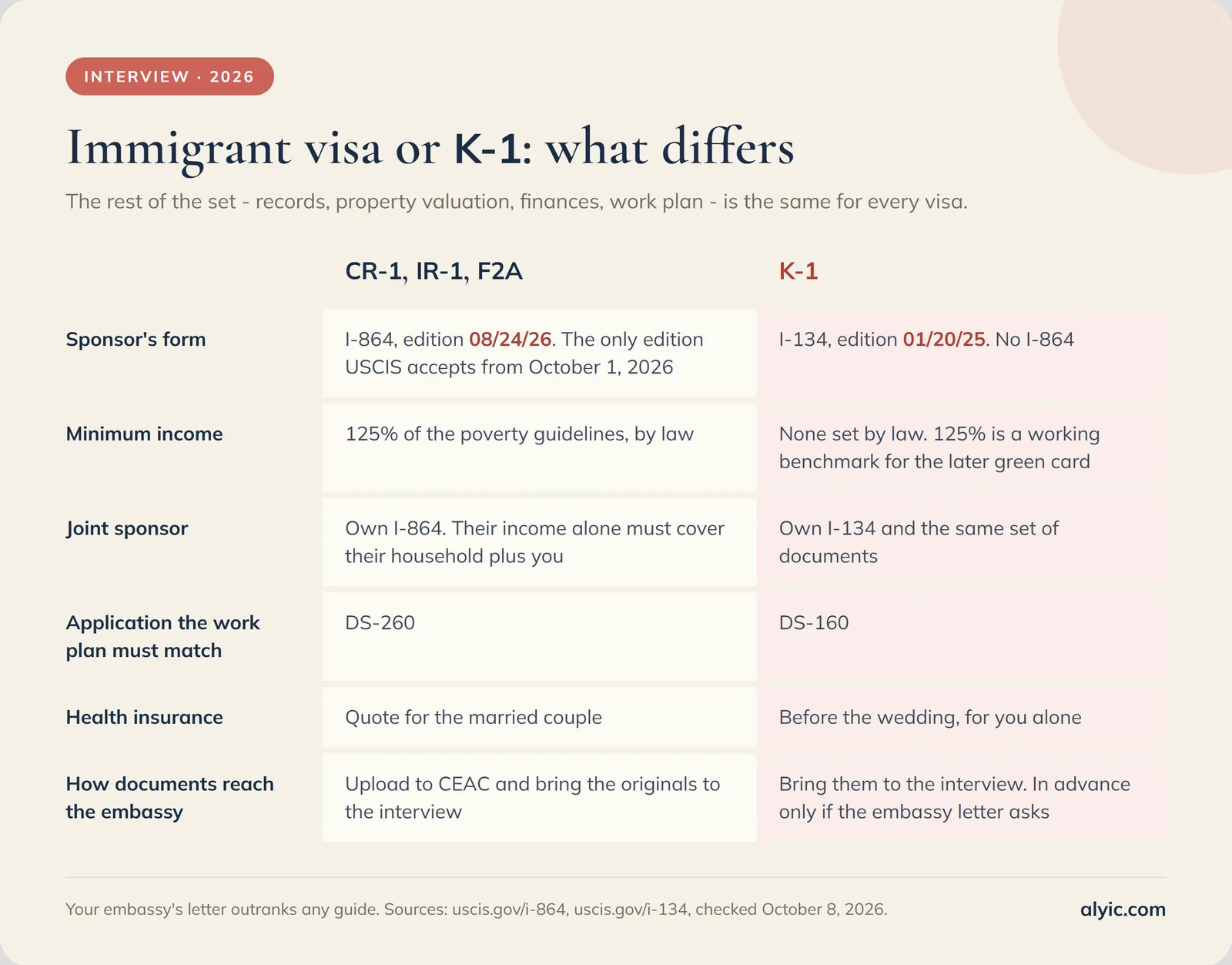
CR-1, IR-1, F2A. I recommend signing a new I-864, edition 08/24/26: from October 1, 2026, USCIS accepts only that edition. The I-864 income minimum is 125% of the federal poverty guidelines (Form I-864P, effective March 1, 2026, 48 states and D.C.): household of 2 - $27,050, 3 - $34,150, 4 - $41,250, 5 - $48,350. Household size counts you too.
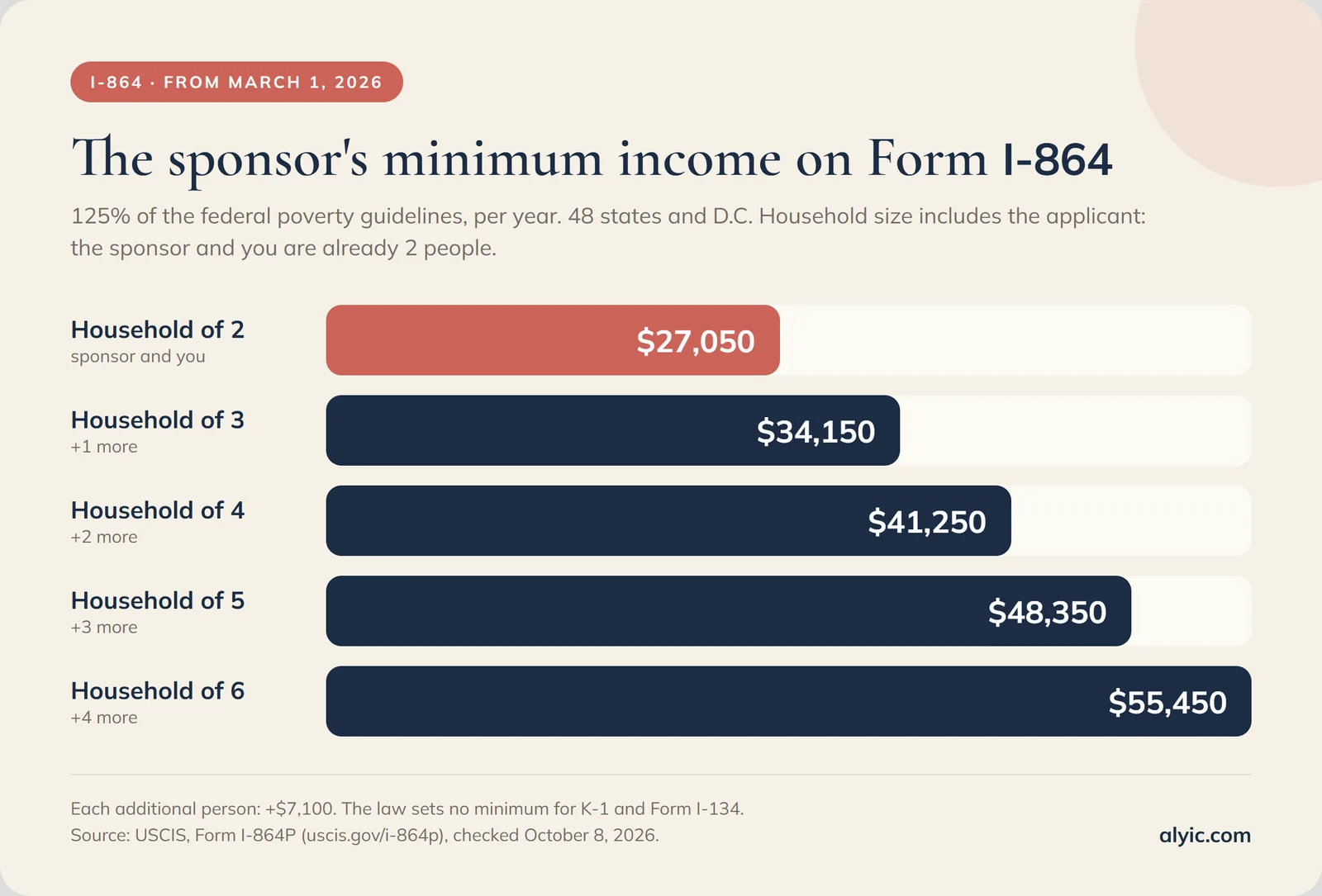
K-1. Forms I-864 and I-864A are not used for the K-1 visa. The sponsor signs Form I-134, Declaration of Financial Support, edition 01/20/25. The law sets no minimum income for the I-134. I use the same 125% benchmark, because that figure will be needed after the wedding, when the green card application is filed with an I-864. But for the I-134 itself it is a working benchmark, not a legal requirement.
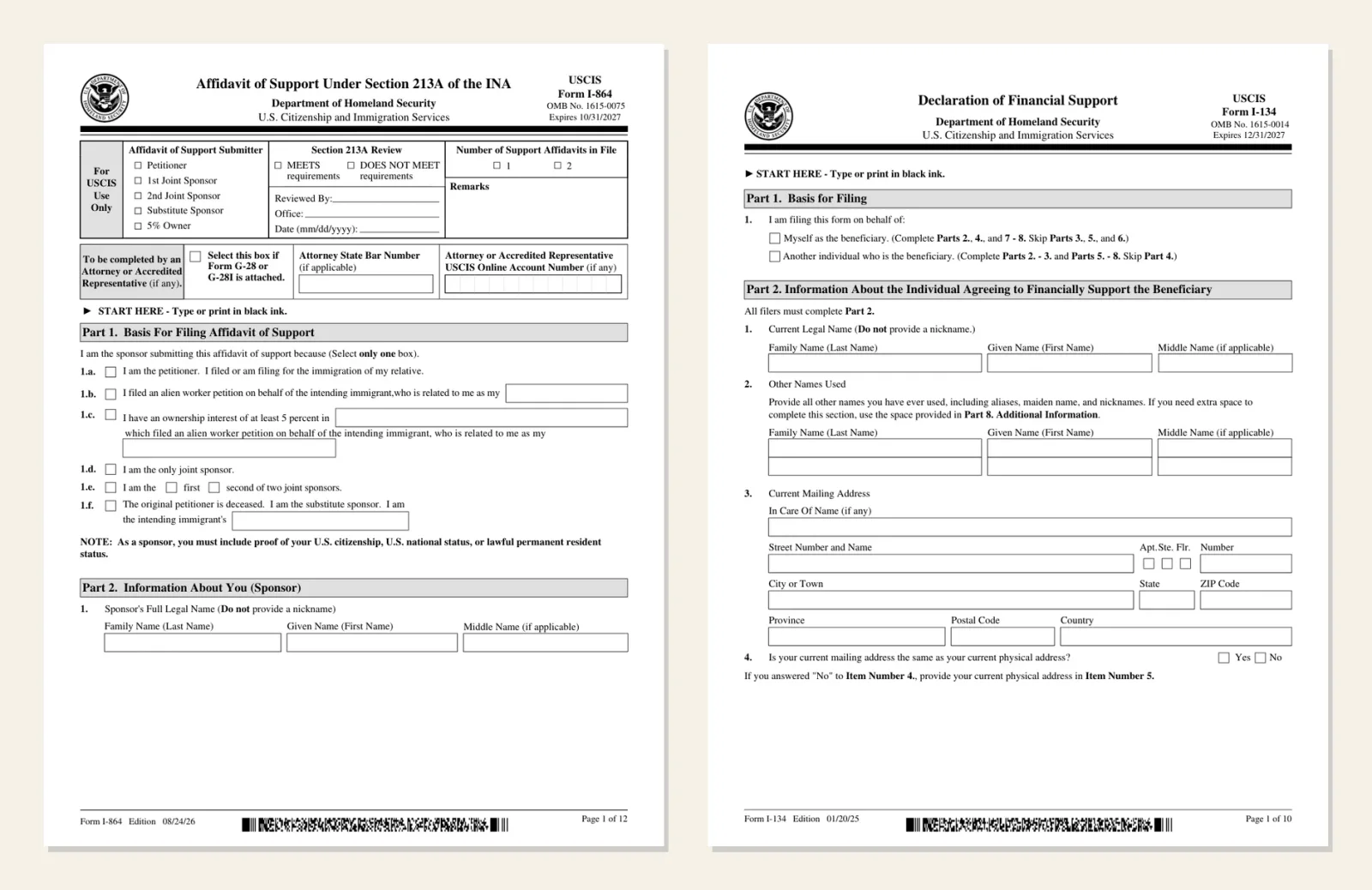
First pages of Form I-864 (edition 08/24/26) and Form I-134 (edition 01/20/25). Source: uscis.gov/i-864, uscis.gov/i-134.
Attach the sponsor's current documents to the form: Form 1040 with W-2 or 1099 or IRS transcripts, pay stubs, an employment verification letter, proof of status, a lease or deed for the home, and bank statements. If the petitioner's income is not enough, a joint sponsor is needed, with their own form (I-864 or I-134) and the same set of documents. For the I-864, their income alone must cover their own household plus you: the petitioner's and the joint sponsor's incomes are not added together.
Relationship evidence and case documents
For every visa type, I recommend adding new relationship evidence dated after the last interview. For K-1, also: a copy of the I-797 approval notice for the I-129F, and letters of intent to marry from you and the petitioner, with a current date. Your birth certificate with translation, divorce certificates (yours and the petitioner's, if there were prior marriages) and a military record if you are subject to military service.
Records if you are not in Kazakhstan
The letter names eGov and bank apps, which are Kazakh services. If your interview is in another country, the guides set out where to get the same records in Russia, Uzbekistan, Kyrgyzstan and Belarus. I also recommend adding property and pension records if you have them.
Property valuation
I recommend attaching the ownership document to the valuation. Cadastral value differs from market value, and the officer may ask about the difference. The numbers in the valuation, the statements and your answers to the officer must match.
Health insurance
If the petitioner can add you to their employer plan, I recommend an HR letter giving the date you can be added, plus a printout of their insurance card. For K-1, keep in mind that employer plans usually add a spouse, not a fiancé(e), so the letter should say you can be added after the wedding.
If there is no employer coverage, the Marketplace Eligibility Notice from HealthCare.gov and the chosen plan with its price. For CR-1 and IR-1 the quote covers the married couple; for K-1, before the wedding, it covers you alone. The guides have a step-by-step walkthrough with screenshots and samples of both documents.
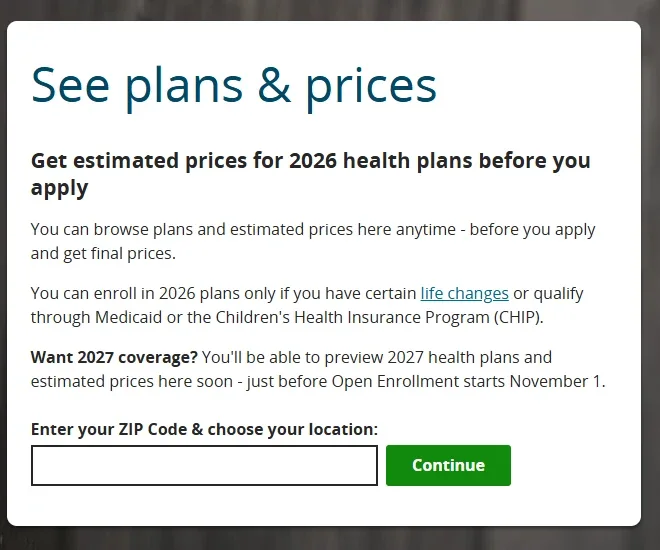
The See plans & prices page on HealthCare.gov shows plans and prices by the ZIP code of your future address. Source: healthcare.gov/see-plans.
Work plan
I recommend one page in English: what work you will do or where you will study, how you will get there and what proves it. Attach a job offer only if it is real. If there is none, print 3-5 matching openings in your future city, with pay. The plan must match the work section of your application: the DS-260 for immigrant visas, the DS-160 for K-1. On K-1, allow for the time until you receive your work permit (EAD): how you will live in the meantime.
Affidavits, translations and explanations
- Affidavits from the beneficiary, the petitioner and the joint sponsor, if there is one. Each guide has its own templates: the immigrant visa set refers to the I-864, the K-1 set to the I-134. They can be filled in right in the PDF.
- A translation of every document that is not in English, together with the original.
- If a document truly cannot be obtained, a short explanation in English: which document, where you asked and what you were told, with a copy of the response. Sign it and include it in place of the document.
Getting your documents to the embassy

CR-1, IR-1, F2A. Upload everything to CEAC (ceac.state.gov/IV): PDF, up to 4 MB per file, a multi-page document as one file, translation and original together. Press Submit. Bring the originals and printouts to the interview.
K-1. Bring the originals and copies to the interview. If the embassy letter asks for documents in advance - by courier, by email or by online upload - do exactly what it says. Keep each translation with its original.
Why family finances are the main question now

Immigration law (INA 212(a)(4)) requires the officer, when assessing public charge, to consider at a minimum the applicant's age, health, family status, assets and financial status, education and skills. That applies to every visa type, K-1 included. The sponsor's form (I-864 or I-134) is a required part of the picture, but not the whole picture.
Look at the Kazakhstan embassy list: most of the new items are about you, not the sponsor. Your credit history, social assistance, your property, your finances, your work plan. The officer builds one story from all of this about how the family will live. If the documents contradict each other or your answers at the interview, it shows immediately.
One more detail for immigrant visas: the new I-864 edition (08/24/26) includes an authorization for USCIS to request information about the sponsor from consumer reporting agencies. A sponsor's debts can now be visible even if nobody asked about them.
What to do now
If the embassy letter has already arrived. Mark every item in it and what you already have. Order your records on day one. At the same time the petitioner completes a new form (I-864 or I-134) and gathers financial documents.
If your interview was moved or is not yet scheduled, and no letter has come. Check the dates on your passport and police certificate. Do not do the medical exam until your interview date is set. Order your credit report and social assistance statement: the embassy in Kazakhstan already asks for them, and they can be ordered online in a few days. Watch your email and case status.
If you are on K-1 and this is your first interview. Gather the core documents (passport, police certificate, birth and divorce certificates; the medical exam once your interview date is set) and the financial set from this article. If the embassy letter asks for more, the letter comes first.
If you have a joint sponsor. They also sign a new form and gather their own set. The officer may ask about them: how they are related to you, where they work and what they earn.
The full guides and affidavit templates
Everything above is set out in detail in two guides in Russian and English: a step-by-step order of actions, where to order each record in five countries, a HealthCare.gov walkthrough with screenshots, a master checklist for your folder and three fillable affidavit templates.
The guides are free. If they helped you or your family, you can thank me on Ko-fi: ko-fi.com/alyhudson. Thank you, it helps me keep making guides like these.
Not legal advice. I am not an attorney. Verify at uscis.gov and travel.state.gov